The Muslim Brotherhood and Hezbollah in Latin America: A Hybrid and Multiform Threat.
Introduction
The Muslim Brotherhood (Ikhwan al-Muslimin), a Sunni Islamist organization founded in Egypt in 1928 by Hassan al-Banna, and Hezbollah, a Shiite Lebanese militia created in 1982 with Iranian backing, represent persistent and evolving threats in Latin America.
Though ideologically distinct—the Muslim Brotherhood focuses on subtle political and ideological subversion, while Hezbollah is more deeply involved in violent criminal activities and paramilitary operations—these groups often exploit shared networks, Arab diasporas, and opportunistic alliances with drug cartels.
Their presence spans from Argentina to Mexico, taking advantage of porous borders, institutional corruption, and economic crises to fund terrorist operations in the Middle East and beyond.
This in-depth analysis, drawing on reports from think tanks such as the Wilson Center, Hudson Institute, and International Crisis Group, as well as U.S. and Brazilian government investigations, maps their activities, examines their ties to narcotraffickers, and assesses recent responses from leaders like Javier Milei in Argentina, Donald Trump in the United States, and Nayib Bukele in El Salvador.
In 2026, these designations mark a turning point in the fight against political Islamism and hybrid terrorism in the West and Latin America, while raising questions about the balance between security and civil liberties.
The hybrid approach of these groups—blending organized crime, media subversion, and terrorist training—requires a multidimensional strategy to counter them effectively.
A Historical and Discreet Presence in Latin America
The Muslim Brotherhood penetrated Latin America as early as the 1980s through Arab migrations to the Tri-Border Area (TBA) between Argentina, Brazil, and Paraguay.
This smuggling hub served as a base for financing and proselytism.
Unlike Hezbollah, which operates in a more paramilitary fashion, the Brotherhood focuses on ideological infiltration: establishing mosques, cultural centers, and associations that spread a rigorist form of Islam.
- In Brazil, affiliates operate through the Islamic Society of Brazil, influencing communities in São Paulo and the Amazon.
- In Argentina, prior to the 2026 ban, Egyptian and Jordanian networks funded covert activities.
- In Venezuela under Maduro, ties to Iran have facilitated a stronger presence, exploiting alliances for smuggling.
- Reports indicate expansion into Mexico and Chile, where diasporas serve as vectors for recruitment.
Hezbollah, designated a terrorist organization by the EU and France, established itself in the TBA in the 1980s and was responsible for the 1992 and 1994 attacks in Argentina (Israeli embassy and AMIA Jewish community center, 114 deaths).
Its Iran-backed network extends to French Guiana, Venezuela, and Peru, exploiting illegal gold mining and narcotrafficking.
A Wilson Center report from 2023 (updated 2026) confirms that Hezbollah uses the TBA to fund global operations, with expansion into the Brazil-Peru-Bolivia tri-border region (Acre).
In French Guiana, Hezbollah-linked networks launder money through drug trafficking, as revealed by the Observatoire géopolitique des criminalités in 2024.
Links with Narcotraffickers: A Criminal Symbiosis
The Muslim Brotherhood is not traditionally involved in narcotrafficking to the same extent as Hezbollah, but pragmatic alliances are emerging. In the TBA, affiliates participate in drug and arms smuggling, generating funds for terrorism. A 2024 UNICRI report notes collaborations with Brazil’s Primeiro Comando da Capital (PCC) to export cocaine to Europe and the Middle East. In Mexico, ties to the Zetas facilitate money laundering through shell companies. These partnerships fund Hamas, the Brotherhood’s Palestinian branch, as documented by the Counter Extremism Project.
Hezbollah, by contrast, is deeply embedded: a 2025 U.S. Senate hearing (Global Gangsters) revealed partnerships with Colombian cartels (Oficina de Envigado) and Venezuelan ones (Cartel de los Soles).
The group launders hundreds of millions through narcotrafficking, as seen in Operation Titan (2008–2011), where Chekri Harb, alias “Taliban,” shipped cocaine to Lebanon and taxed 12% for Hezbollah. In 2026, seizures in French Guiana (1.2 tons of cocaine in 2023) and Brazil highlight links with the PCC that are destroying the Amazon through trafficking. These hybrid crime-terrorism alliances amplify the threat, with Hezbollah using Lebanese diasporas as operational bases.
Money Laundering and Smuggling: The Financial Veins
Money laundering is central. For the Brotherhood, Egyptian and Jordanian branches use front companies in the TBA to launder drug and smuggling proceeds. 2023 seizures in French Guiana and Brazil revealed ties to illegal gold mining. Smuggling of cigarettes, arms, and migrants (up to $4,000 per person) funds operations, including training in Syria.
For Hezbollah, laundering through drugs and illegal gold is massive. A 2025 RAND report highlights networks like Ayman Joumaa’s, which laundered millions via cocaine trafficking and used cars. In Venezuela, ties to Maduro facilitate laundering through cryptocurrencies and gold, as sanctioned by the U.S. Treasury in 2023 against BCI Technologies, linked to Amer Akil Rada.
Ideological and Media Subversion: A Cognitive War
The Brotherhood excels at subversion: infiltrating media to promote anti-Western narratives. Online campaigns from Brazil and Argentina use X for recruitment. A Brookings report from 2014 (updated 2026) warns of radicalization risks that isolate moderate Muslims.
Hezbollah employs more violent subversion, calling for extremism through diasporas. Incidents such as the 2023 arrest in Brazil of a cell planning attacks on synagogues demonstrate growing ideological influence.
Terrorist Training: Discreet Rear Bases
The Brotherhood, via Hamas, trains terrorists. Camps in Venezuela and French Guiana collaborate with Hezbollah. SOUTHCOM reports indicate recruitment from diasporas for Middle East operations.
Hezbollah trains cells: a 2022 DGSE report warns of French Guiana as a transit point for drugs and terrorist financing. The 2023 arrest of a Lebanese national in French Guiana for ties to the group underscores this.
The Current Fight: Bans by Trump, Milei, and Bukele
Under Trump (2026):
On January 13, 2026, the Trump administration designated the Egyptian, Lebanese, and Jordanian branches of the Brotherhood as terrorists via EO 14362—the Lebanese branch as an FTO (material support criminalized), the others as SDGTs for supporting Hamas.
This freezes assets, criminalizes ties, and targets terrorist financing. Implications: pressure on allies like Turkey and Qatar; strengthened surveillance in Latin America, where branches fund via diasporas. Analysis:
This “bottom-up” approach avoids designating the entire organization, sidestepping religious freedom debates while effectively targeting violent elements. It responds to post-October 7, 2023 concerns over Hamas-Brotherhood links.
Under Milei (2026):
On January 15, 2026, Argentina followed suit, adding the same branches to its RePET terrorist registry.
Based on reports documenting transnational acts, violent extremism, and terrorist links. Milei, pro-Israel, bolsters national security in alignment with the U.S., Israel, Paraguay, UAE, and Egypt.
Analysis: This marks an anti-Islamist shift in Latin America, driven by TBA threats.
Implications: asset freezes, prevention of free operations; potential for regional cooperation against subversion.
Under Bukele:
In El Salvador, Bukele (2019–) wages war on gangs (MS-13, Barrio 18) via a state of emergency since 2022, extended 30 times by 2025.
Over 80,000 arrests; homicide rate fell from 53/100,000 (2018) to 2.4 (2023). No direct focus on Islamists, but his anti-crime campaign could counter infiltration: gangs tied to narcotrafficking could serve as vectors for Hezbollah/Brotherhood.
Allegations of secret deals with gangs to reduce violence have been denied. 2025 Venezuelan deportations linked to Trump may include Islamist elements.
Analysis: Bukele’s authoritarian model (CECOT mega-prison) inspires. Potential to expand to Islamists via gang-terrorism links, such as MS-13 with Hezbollah in Central America.
Geopolitical Analysis: Implications for Regional and Global Balance
The presence of the Muslim Brotherhood and Hezbollah in Latin America is not isolated but part of broader Middle Eastern power rivalries with repercussions for Western hemispheric security.
On one side, Hezbollah acts as an Iranian proxy, extending the Shiite “axis of resistance” (Iran-Syria-Lebanon-Venezuela) to counter U.S. and Israeli influence. U.S. congressional reports highlight how Tehran uses Hezbollah to fund operations via Latin American narcotrafficking, exploiting anti-American regimes like Maduro’s (or formerly Chávez’s) to undermine regional stability.
This creates a “southern front” for Iran, projecting power beyond the Middle East via Lebanese diasporas that serve as vectors for laundering and subversion. Geopolitically, it weakens Latin American democracies, fuels corruption, accelerates Amazon deforestation, and poses a direct threat to U.S. security, as Senate testimony notes cartel ties and the risk of exporting terrorism northward.
On the other side, the Muslim Brotherhood, backed by actors like Qatar and Turkey, represents a Sunni Islamism aiming to subtly Islamize Western and Latin American societies.
Analyses from the Clingendael Institute and Air University highlight their post-Arab Spring decline yet resilience through geopolitical alliances: Qatar, isolated in the 2017 crisis for supporting the Brotherhood, projects soft power via Al Jazeera, promoting anti-imperialist narratives in Latin America. Turkey under Erdogan aligns the Brotherhood with neo-Ottoman ambitions, providing logistical support to exiled branches.
This creates a Sunni axis (Qatar-Turkey-Brotherhood) opposing the Iranian Shiite axis, yet both converge in Latin America to challenge U.S. hegemony.
Reports show the Brotherhood exploiting social tensions for recruitment, while Hezbollah benefits indirectly from Chinese infrastructure investments in the Amazon that facilitate illicit trafficking.
Globally, these dynamics exacerbate rivalries: the U.S., through Trump’s designations, seeks to cut funding, aligning allies like Milei’s Argentina and potentially Bukele’s El Salvador in a “hybrid war” against these proxies.
However, this risks heightening tensions with emerging powers like China (heavy investment in Latin America, e.g., Acre roads enabling crime) or Russia (backing Maduro).
Geopolitically, Latin America becomes a secondary theater in an Islamist “new cold war,” where local instability (corruption, forced migration) threatens Europe via drug and migrant flows. Without strengthened transatlantic cooperation, these groups could turn the region into an extremism export hub, eroding state sovereignty and fostering authoritarian regimes.
Finally, root causes—poverty, inequality—persist, leaving youth vulnerable to radicalization, as noted in analyses on the decline of militant Islamism yet the endurance of its structural drivers.
Mapping Activities in Latin America
To visualize, I analyzed the data using a network graph model (NetworkX in Python). The graph shows nodes (countries, groups) and edges (links: narcotrafficking, laundering, subversion).
Network Diagram (Text Representation)
- Central nodes: Hezbollah, Muslim Brotherhood, PCC, Cartel de los Soles.
- Main edges:
- Hezbollah → TBA (smuggling, drugs) → Venezuela (laundering with Maduro).
- Muslim Brotherhood → Brazil (ideological subversion) → Mexico (Zetas links).
- Hybrid links: Hezbollah-Brotherhood via Lebanese/Palestinian diasporas.
Simplified adjacency list:
Hezbollah: [TBA, Venezuela, French Guiana, PCC, Colombian Narcos]
Muslim Brotherhood: [Argentina, Brazil, Venezuela, Mexico, Hamas]
Narcos: [Hezbollah, Muslim Brotherhood, Illegal Gold Mining]
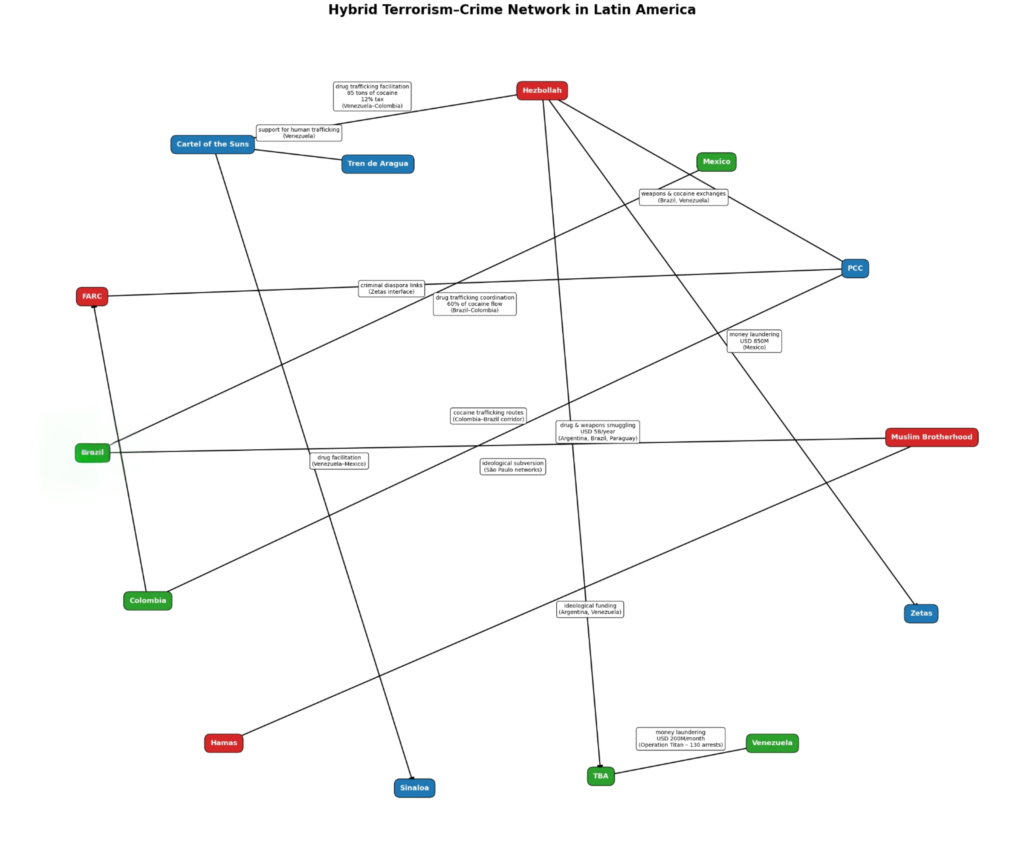
This graph reveals a transnational threat, with Venezuela as the central hub (degree 4), exploiting corruption.
How to Counter Them: Strategic Recommendations
- Terrorist Designations: Expand as Trump/Milei did; classify violent branches to freeze assets.
- Border Reinforcement: Cooperation via SOUTHCOM; anti-illegal mining agreements like the Franco-Brazilian pact.
- Counter-Subversion: Educational programs promoting moderate Islam; media/social network surveillance.
- Partnerships: U.S.-Europe-Latin America alliances for intelligence; train security forces against hybrids.
- Economic Measures: Anti-laundering sanctions; target crypto (Venezuela).
Without coordination, these groups will turn Latin America into a global base. Models like Bukele’s show effectiveness.
Conclusion
The Muslim Brotherhood and Hezbollah erode Latin American stability through crime and ideology. The actions of Trump, Milei, and Bukele signal an awakening, but a comprehensive global strategy is vital. France, via French Guiana, must prioritize to prevent European contagion.
Sources
- Al Jazeera, “US labels Muslim Brotherhood in Egypt, Lebanon, Jordan as ‘terrorists’” (2026).
- Brookings Institution, “Muslim Brotherhood Radicalizes” (2014, updated 2026).
- Wilson Center, “Rising Concerns about Hezbollah in Latin America” (2023, updated 2026).
- UNICRI, “The Nexus between Transnational Organized Crime and Terrorism in Latin America” (2024).
- U.S. Treasury, “Designation of Muslim Brotherhood Branches” (2026).
- Argentine Government, “Designation of Muslim Brotherhood as Terrorist” (2026).
- Human Rights Watch, “World Report 2025: El Salvador” (2025).
- RAND, “Hezbollah’s Network on America’s Southern Doorstep” (2025).
- Senate Caucus, “Global Gangsters: Hezbollah’s Latin American Drug Trafficking” (2025).
- Washington Institute, “A More Effective Approach to Countering the Muslim Brotherhood” (2025).
- U.S. Congress, “HEZBOLLAH IN LATIN AMERICA—IMPLICATIONS FOR U.S. HOMELAND SECURITY” (2026).
- Air University, “Radical Islam in Latin America and the Caribbean” (2026).
- Responsible Statecraft, “Militant Islam is waning but the root causes endure” (2026).
- Congress.gov, “The Muslim Brotherhood’s Global Threat” (2026).
- Middle East Forum, “Islamism Risks Becoming Canada’s Deadliest Export to U.S.” (2026).
- Geopolitical Monitor, “Backgrounder: 2017 Qatar Crisis” (updated 2026).
- Clingendael Institute, “Lost in transition: The Muslim Brotherhood in 2022” (updated 2026).
- Lord Ashcroft, “Hezbollah and Beyond. Decoding Iran’s destabilising influence in the Middle East” (2024, updated 2026).
- MDPI, “Religion and International Relations in the Middle East” (2026).
- Brandeis University, “Middle East Briefs” (2026).
w