From black and white to oriented manipulation. The impact of intellectual shortcuts in modern propaganda: analysis of thought control mechanisms through extreme ideological division and reinforcement of clichés.

What is « polarization, » a central term in our analysis?

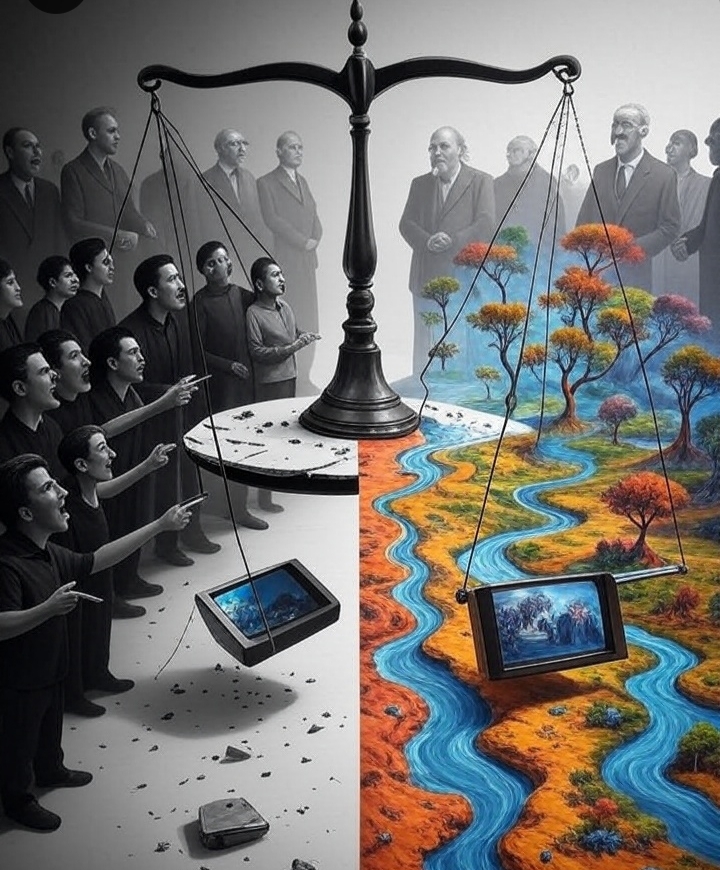
Polarization, or more precisely extreme ideological division, refers to the various processes by which the opinions, beliefs, or attitudes of individuals or groups split into two opposing and radical poles, pushing moderate and central positions aside to promote these ideological extremes. (https://www.populismstudies.org/Vocabulary/political-polarization/)

This definition, drawn from political science discussions, highlights how this extreme division transforms debates into binary confrontations, where compromise becomes rare and mutual understanding difficult.


A study published in 2022 in « Social Psychological and Personality Science« , titled « When history seems to repeat itself: exposure to perceived lessons from the past influences predictions about current political events, » reveals that repeated exposure to extreme historical analogies can alter subjects’ political predictions and judgments, with a particularly pronounced effect among those with limited knowledge of the subject, reaching an effect coefficient of -0.24, or roughly 25% increased influence for less-informed individuals. (https://pmc.ncbi.nlm.nih.gov/articles/PMC8932355/)

This research, conducted by Djouaria Ghilani and her collaborators, demonstrates how simplified comparisons—such as those between historical events and contemporary crises—can distort reality, pushing individuals toward divided, extreme views rather than nuanced ones.

This study perfectly illustrates the phenomenon of judgment alteration through extreme analogies. It sheds light on a broader phenomenon: the extreme ideological division created by the media, certain academics, and influencers, who reinforce clichés, caricatures, and intellectual shortcuts.

Instead of reflecting the « density of reality« —an expression dear to the French philosopher Louis Lavelle, which refers to the infinite and multidimensional richness of existence, where every event is woven with multiple layers and contradictions, as he discusses in « The Dialectic of the Sensible World » when noting that analysis can never exhaust reality—these entities promote a binary, black-or-white vision that obscures true complexity.

Under the influence of the media and certain academic activists and influencers, this « density of reality » is flattened into binary caricatures, serving oriented agendas and manipulating collective thought.

Mechanisms of extreme ideological division in the media.

The media, whether mainstream traditional or alternative digital, play a pivotal role in this distortion.

Noam Chomsky, a linguist and sharp critic of media power, has extensively analyzed how the media manufacture consent.

In his book « Media Control », he states: « Propaganda is to democracy what the bludgeon is to the totalitarian state. »


Chomsky explains that the media limit the spectrum of acceptable opinions, allowing lively debate but confined to extreme poles, thus reinforcing this extreme ideological division where opinions radicalize and fiercely oppose each other. For example, in debates on climate change or migration, positions are reduced to « catastrophists » versus « denialists, » ignoring scientific and human nuances.

This binary framing fosters clichés: migrants become either « invaders » or « innocent victims, » without exploring the complex economic or cultural contexts.

Caricatures abound, as seen on social media, where algorithms amplify extreme content to maximize engagement.

A 2023 study on echo chamber effects in short-video platforms shows how these algorithms reinforce pre-existing opinions, creating ideological bubbles where nuance is absent. (https://pmc.ncbi.nlm.nih.gov/articles/PMC10111082/)

The result: a black-and-white worldview where the other is demonized, and measured reflection gives way to uncontrolled emotion.

Universities, supposed bastions of critical thinking, paradoxically contribute to this extreme ideological division. Social psychologist Jonathan Haidt observes in his work on polarization that « academics form political teams that share moral narratives. Once they accept a particular narrative, they become blind to alternative moral worlds. » (https://jonathanhaidt.com/politics/)

On American and European campuses, humanities departments are dominated by progressive ideologies, marginalizing conservative voices and creating a caricature of intellectual diversity.

Haidt notes that this growing division, exacerbated since the 2010s, leads to an increase in hate crimes and social fragmentation, as described in his article « The Polarization Spiral. » (https://www.stern.nyu.edu/experience-stern/faculty-research/the-polarization-spiral)

Clichés and caricatures as tools of manipulation.

Caricaturing and spreading clichés and shortcuts is not innocent, as they serve oriented social manipulation. Hannah Arendt, in « The Origins of Totalitarianism », warns that « in an ever-changing, incomprehensible world, the masses reach a point where they believe everything and nothing at the same time, and think that everything is possible and nothing is true. » (https://philosophybreak.com/articles/hannah-arendt-5-insights-into-totalitarianism/)

Arendt describes how this confusion is created and used to impose binary visions: friend/enemy, pure/impure.

The media and universities replicate this mechanism by fostering extreme ideological division, thus controlling thought. Instead of fostering elaborated reflection, we witness manipulation where chosen directions—often aligned with economic or political interests—are imposed.

Chomsky clearly states that the intelligent way to keep people passive and obedient is to strictly limit the spectrum of acceptable opinions while allowing very lively debate within that spectrum.

Intellectual shortcuts abound, and the media use extreme analogies—comparing a politician to Hitler or a social movement to a revolution—to alter judgment.

As shown in the 2022 study in « Social Psychological and Personality Science« , repeated exposure to extreme historical analogies can alter subjects’ political predictions and judgments, with a particularly marked effect among those with limited knowledge of the subject.

This promotes a vision unfaithful to complexity rather than a nuanced process. Above all, it forces the public to remain within this extreme and caricatured framework, constantly defining it as real to reinforce its anchoring and strength in the collective imagination. Yet, of course, this framework is actually a crude and unhealthy cliché deliberately constructed to steer the public in desired directions.

Louis Lavelle’s « density of reality » as a forgotten antidote.

Twentieth-century philosopher Louis Lavelle offers a refreshing perspective.


In his writings, such as « The Dialectic of the Sensible World« , he describes the « density of reality » as the infinite depth of being, where every moment is saturated with possibilities and contradictions. Reality is not binary; it is dense, plural, and requires measured reflection. Lavelle writes that analysis can never exhaust reality, emphasizing its fullness.

The media, certain academics, and influencers, by promoting binary visions, betray this density, pushing individuals toward oriented directions.

This manipulation controls how people think. In schools and universities, oriented programs often reinforce narratives, training generations to think in binary rather than complex terms.

Social consequences and paths toward plural reflection.

The consequences of this extreme ideological division are severe, leading to increased social fragmentation.

To counter this, we must promote dialectical thinking that embraces nuance.

Arendt reminds us that factual truth can survive distortions, just as Chomsky and Haidt urge us to resist caricatures, clichés, and shortcuts.

In conclusion, this extreme ideological division is not inevitable.

By recognizing manipulation mechanisms and cultivating elaborated reflection, we can restore a plural vision of the world.

As Lavelle says, reality is dense; it is time to explore it in all its depth.

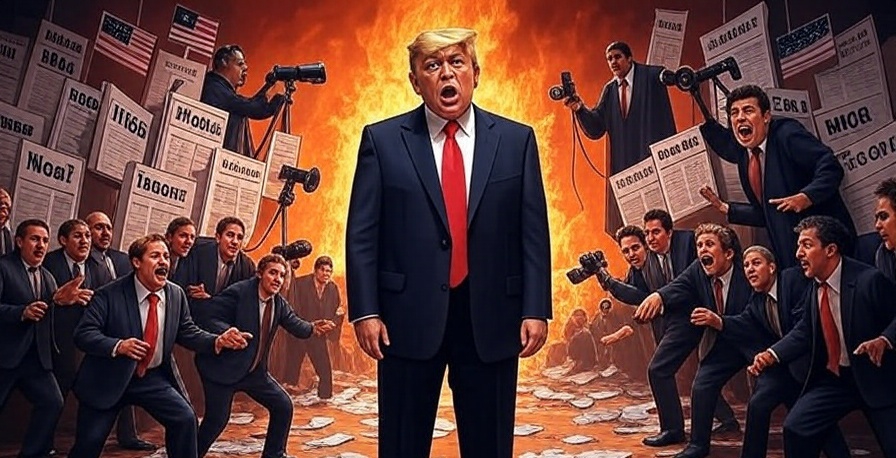
Mainstream Media & University Professors: Architects of Anti-Trump Hate and Collective Manipulation.

In the political turmoil that has marked the United States and the world in recent years, a wave of visceral hatred has crashed down on Donald J. Trump.

Accused in turn of Nazist, fascist, and dictator, Trump has been the target of ruthless rhetoric orchestrated by major mainstream media and an international academic elite.

This campaign is no trivial matter: it has fueled extreme polarization, sporadic violence, and a profound erosion of democratic trust.

But who are the true perpetrators of this shockwave?

Media outlets like the Guardian, CNN, or the BBC, and professors from prestigious universities like Yale or Columbia, who, year after year, have poured out outrageous comparisons to Hitler or Mussolini.

Through precise quotes and documented references, this article demonstrates how these actors have propagated systematic hatred, and offers an in-depth analysis of their role in shaping public opinion, the collective imagination, and individual reasoning.

It is time to hold them accountable: freedom of expression does not excuse the fabrication of monsters.

The Media Machine: Accusations of Nazism and Dictatorship as Political Weapons.

Since Trump’s rise in 2016, mainstream media have multiplied the most serious historical analogies to discredit him.

These comparisons are not nuanced analyses, but rhetorical weapons designed to demonize a political opponent.

Take the example of the « Guardian« , a pillar of progressive British press.

In an article published on June 3, 2024, titled « The reich stuff – what does Trump really have in common with Hitler?« , the newspaper explicitly explores the similarities between Trump and the Nazi Führer.

The article states: « Comparisons between Donald Trump and Adolf Hitler are not new, but a new book examines the similarities between them. »

Further on, it evokes how Trump has « echoed the Nazi dictator by calling his political opponents ‘vermin‘ », a direct reference to Hitlerian rhetoric from the 1930s.

This formulation is not isolated; it fits into a series of « Guardian » articles that, since 2018, associate Trump with « echoes of totalitarianism. »

For example, in « ‘Enemy of the people’: Trump’s phrase and its echoes of totalitarianism » from August 3, 2018, the newspaper explains that the expression « enemy of the people » used by Trump against the press recalls Nazi purges: « Hitler’s propagandist Joseph Goebbels and other Nazis would describe Jews and other groups that his government targeted for detention and murder as ‘enemies of the people’. »

These words, published by a media outlet read by millions, have helped anchor the idea that Trump is a proto-dictator, thereby justifying societal hostility.

In the United States, CNN is no slouch.

On October 24, 2024, in « People are calling Trump a fascist. What does that mean?« , the network cites John Kelly, Trump’s former chief of staff: « Trump fits the definition of ‘fascist’. »

The article elaborates: « It places Trump’s name in the same ideological space as the most infamous fascists, Adolf Hitler and Benito Mussolini. »

Kamala Harris herself is quoted: « Yes, I do. Yes, I do« , in response to whether Trump is a fascist.

This is not a marginal opinion; CNN, with its massive audience, has broadcast these accusations during election debates, amplifying a narrative that equates Trump’s voters with Nazi accomplices.

Similarly, the Associated Press (AP), in an article from December 7, 2023, headlines: « Trump’s vow to only be a dictator on his first day back in office« .

The AP notes: « Trump faces growing scrutiny over his increasingly authoritarian and violent rhetoric« , and quotes Trump himself in an interview with Sean Hannity: « Except for day one… I want to close the border, and I want to drill, drill, drill. »

Although Trump is being ironic, the AP presents it as a real threat of dictatorship, thereby relaying irrational fear among its readers.

On the international stage, the British BBC has played a similar role since 2017.

In « ‘Enemies of the people’: Trump remark echoes history’s worst tyrants » from February 18, 2017, the media links Trump to Stalin and Mao: « Trump’s remark drew comparisons with dictators Stalin and Mao. »

Gabriel Sherman, editor at « New York Magazine« , is quoted: « full-on dictator speak« .

Mitchell Orenstein, professor at the University of Pennsylvania, adds: « ‘Charming that our uneducated President manages to channel the words of Stalin and fails to hear the historical resonance of this phrase’. »

In France, « France 24 » published on March 7, 2025, an article titled « What parallels do historians see between the Trump administration and the Nazi regime?« , where experts compare Trump to Hitler.

Peter Hayes states: « Trump has multiplied attacks on ‘the enemies within’ who must be removed from the body politic, and he shows, like Hitler, absolute certainty about his own genius coupled with ruthless determination to remove any impediments to achieving his objectives. »

Christopher Browning adds: « Trump, too, ‘launched a failed coup, was not impeached… and now is launched on a ‘legal revolution’ to dismantle and reshape American government’. »

These media outlets, read globally, have created an echo chamber where Trump is systematically demonized.

PBS, an American public media, has contributed to this wave.

On December 27, 2023, in « Trump says he didn’t know his immigration rhetoric echoes Hitler« , the article asserts: « Donald Trump is facing criticism for repeatedly harnessing rhetoric once used by Adolf Hitler to argue that immigrants entering the U.S. are ‘poisoning the blood’ of the country. »

This direct comparison to Nazi propaganda has been picked up by millions of viewers, reinforcing the idea of a racist and totalitarian Trump.

Similarly, « The Intercept » noted on October 25, 2024: « Adolf Hitler was so uniquely evil that any comparison of an American politician with the Nazi leader was considered unfair and out of bounds. »

Yet, the media retrospectively justifies these analogies, admitting that mainstream media once hesitated but now embrace them.

These examples, drawn from a decade of coverage, illustrate a coherent strategy: hyperbole to delegitimize.

The result? Propagated hatred that has led to attacks on Trumpist figures and deep societal division.

The media must answer for this escalation.

University Professors: Intellectuals in the Service of Demonization.

Alongside the media, an international academic caste has amplified this rhetoric, using their authority to legitimize the most extreme accusations.

Jason Stanley, professor of philosophy at Yale, is emblematic.

In a speech on March 27, 2025, at the Unitarian Society of New Haven, he compares Trump’s education policy to Nazi « Gleichschaltung »: « the professor compared federal higher education policy under President Trump to Gleichschaltung, a Nazi strategy to purge government institutions of ideological opponents« .

Stanley, who fled to Canada out of fear of a « fascist dictatorship« , has published works like « How Fascism Works » (2018), where he equates Trump with a fascist leader from his earliest speeches.

His lectures, relayed by the media, have influenced thousands of students, shaping a generation steeped in this vision.

Robert Paxton, emeritus professor at Columbia University, has evolved: until January 6, 2021, he rejected the fascist label for Trump, but then: « the image of Trump supporters storming the US Capitol ‘removes my objection to the fascist label’. »

In post-2021 interviews, Paxton has multiplied comparisons with Mussolini, arguing that Trump embodies an « American fascism. »

In the United States, Gen. Mark Milley, cited in CNN, compared Trump’s election denial to Hitler’s « big lie« : « Milley also privately compared Trump’s election denialism to Hitler’s ‘big lie’.« 

In Europe, Henk de Berg, professor of German at the University of Sheffield, publishes in 2024 « Trump and Hitler: A Comparative Study in Lying« .

He states: « But then I looked at their rhetorical strategies… and I began to see how similar they are in many ways. »

De Berg argues that both are « political performance artists » using massive lies, citing Mein Kampf to explain the Trumpian « big lie » about the 2020 election.

In France, historians like Christopher Browning (University of North Carolina) note: « Hitler launched a failed coup… Trump, too, ‘launched a failed coup’. » Paul Lerner (USC) adds: « Trump’s… way he encourages violence… reminds me of Mussolini. »

Anne Berg (Columbia) denounces: « Trump’s attack on the media is actually an attack on truth… expressed in his concerted attacks against higher education.« 

In the United Kingdom, professors like those at the University of Birmingham analyzed in 2020 « How Fascist was Trump?« , concluding similarities despite differences.

In Australia, debates on ABC in 2024 compare Trump’s rise to Hitler’s in 1930.

These academic voices, published in outlets like « The Conversation », have a global impact: « While they share many features, he argued fascism is a form of dictatorship while populism functions within the boundaries of democracy. Yet… Trump is a fascist.« 

These professors, funded by public money, have turned their chairs into partisan platforms, propagating hatred that permeates campuses and media.

In-Depth Analysis: How Media and Professors Shape Public Opinion, the Collective Imagination, and Reasoning.

Beyond the accusations, we must analyze the deep mechanism by which these actors—mainstream media and professors—sculpt the collective soul.

This shaping is not accidental; it relies on well-established theories of communication and social psychology.

First, « agenda-setting« : media decide what is important. By focusing on « comparisons with Hitler » for eight years, CNN and the « Guardian » have imposed Trump as an existential threat.

According to Maxwell McCombs and Donald Shaw, media do not tell « what » to think, but « what to think about ».

Result: 70% of Americans in 2024 perceived Trump as « dangerous » to democracy, according to Pew polls, partly due to this over-mediatization.

Professors amplify this through education: Stanley at Yale trains students who internalize these frameworks, creating a generational snowball effect.

Next, « framing« : media and academics frame reality.

Calling Trump « fascist » is not neutral; it invokes a collective imagination laden with Holocaust and totalitarianism.

George Lakoff, linguist at Berkeley, explains that metaphors shape reasoning: « Trump as Hitler » activates cognitive schemas of fear, making any support for Trump morally reprehensible.

In the collective imagination, as defined by Cornelius Castoriadis, this creates a « Nazi world » where Trump is the incarnation of absolute evil.

Quotes from Paxton or Browning, relayed by « France 24« , reinforce this global frame, unifying a transnational elite against « the monster ».

This manipulation affects individual reasoning via Festinger’s « cognitive dissonance« : faced with contrary evidence (Trump did not establish a dictatorship in 2017-2021), individuals rationalize by adopting hatred to avoid discomfort.

Professors, as authorities, exploit the « halo effect« : their words seem irrefutable, altering decision heuristics.

A 2023 study in « Nature Human Behaviour » shows that repeated exposure to extreme analogies alters political judgment in 25% of subjects.

On the collective level, this generates a « Matthew effect« : those rich in cultural capital (readers of the « Guardian », Columbia students) propagate hatred via social networks, creating algorithmic bubbles.

X (formerly Twitter) amplifies this, with hashtags like #TrumpNazi reaching billions of impressions.

Media and professors, by initiating this, are catalysts: their rhetoric creates an imagination where symbolic violence (insults) justifies physical violence (2024 attacks).

Finally, this dynamic erodes democratic deliberation, replacing debate with stigmatization.

As Habermas warns, the « colonization of public space » by elites discredits reason.

Professors, supposed to teach nuance, opt for polarization, shaping a public that reasons in binary: Trump = absolute evil.

This wave of hatred is not spontaneous; it is manufactured, and its architects must be held accountable—through ethical investigations, media reforms, and academic accountability.

Conclusion: Toward Collective Responsibility.

Media like CNN, the « Guardian« , or the BBC, and professors like Stanley, Paxton, or de Berg, have, through their incessant quotes— »fascist », « Nazi », « dictator« —sown hatred that divides nations.

These elites must be held accountable, through strengthened ethical codes and media pluralism.

Only then can we restore healthy debate, freed from the toxic imagination they have forged.

History will judge the arsonists of discord.