$2.7 trillion stolen.
How the Chávez–Maduro regime turned Venezuela into a sailed State — and a global criminal hub.
Nine million refugees. No war. No invasion. Just a regime.
Contents.
– From Prosperity to Collapse: The Destruction of a Once-Wealthy Nation.
– Kleptocracy as State Policy: The Chávez–Maduro System.
– Corruption, Narco-Trafficking, and the Criminal Economy.
– Political Repression and the Dismantling of Democracy.
– International Alliances and Terror Financing.
– The Human Cost: Poverty, Violence, and Mass Exodus.
Introduction.
Venezuela under Nicolás Maduro stands as a monument to human depravity — a country once crowned with immense oil wealth, now transformed into an abyss of misery and terror.
Imagine a national treasure of over 300 billion barrels of oil — the largest proven reserves on Earth — squandered in a historical instant, leaving a nation that once ranked fourth worldwide in GDP per capita (in the 1950s, behind the United States, Switzerland, and New Zealand) to collapse to between 140th and 150th place, trailing Niger, Chad, and even Haiti.
Venezuela’s historic collapse: from developed economy to failed state (1950–2026).

Estimates for the 1950–1989 period rely on orders of magnitude derived from reference historical research (such as the Maddison Project), while post-1990 trends are consistent with patterns observed in international databases (World Bank / IMF, GDP per capita in purchasing power parity).
The series have been smoothed to allow coherent visual comparison over time and to illustrate Venezuela’s relative evolution compared to other countries and the global average.
This systematic plunder—estimated at the astronomical figure of $2.7 trillion laundered and diverted, or 27 times the Marshall Plan that rebuilt postwar Europe—is not a historical accident, but a deliberate strategy of kleptocracy.
Illicit oil flows through PDVSA, illegally mined gold from the Orinoco Mining Arc, and rampant drug trafficking orchestrated by the Cartel of the Suns (Cartel de los Soles) have financed a sprawling network of terrorism, electoral fraud, and toxic geopolitical alliances.
The arrest of Nicolás Maduro on January 3, 2026, by U.S. special forces during Operation “Absolute Resolve”—a bold raid on a Caracas bunker that cost approximately 80 lives, including Cuban and Venezuelan guards—marks a decisive turning point, a ray of hope.
The Venezuelan people have been martyred by extreme poverty (94% of the population), child malnutrition (over 30% in rural regions), a massive exodus (nearly 9 million refugees since 2014), and a staggering homicide rate (around 60 per 100,000 inhabitants in 2025, driven by gangs such as the Tren de Aragua and the colectivos, motorcycle-based gangs that hunt down citizens opposed to Maduro), as well as by:
- Censorship and closure of media outlets (at least 405 media outlets shut down over the past 20 years; more than 60 websites blocked and at least 14 radio stations closed in 2024, severely restricting access to independent information).
Source: Freedom House - Persecution, imprisonment, and suppression of journalists and organizations (at least 70 violations of press freedom within 15 days after the 2024 elections, including 9 journalist detentions—4 still imprisoned—9 expulsions of foreign journalists, and physical attacks; several journalists charged with “terrorism”).
Source: Reporters Without Borders - Arbitrary arrests and political detention (over 2,000 arrests since the 2024 election for protest, criticism, or opposition, with sentences of up to 30 years in prison based on vague charges such as “incitement to hatred” or “terrorism”).
Source: Human Rights Watch - Torture and ill-treatment in detention (Provea documented more than 2,200 victims of cruel, inhuman, or degrading treatment in 2024, including at least 60 cases of torture; reports include electric shocks, suffocation, and prolonged isolation).
Source: Provea - Kidnappings and enforced disappearances (Amnesty International documented at least 15 enforced disappearances since July 2024, with at least 11 people still missing, and hundreds of potential cases identified by NGOs).
Source: Amnesty International - Killings and extrajudicial executions (credible reports indicate 24–25 people killed during post-election protests in late July–August 2024, several involving security forces or pro-government groups).
Source: Amnesty International - Massive electoral fraud and lack of democratic transparency (international observers such as the Carter Center and the UN electoral technical mission stated that the 2024 elections lacked transparency, official tally sheets were not published, and legally required audits were not conducted).
Source: Human Rights Watch - Expropriation of businesses and land (since the 2000s, the Venezuelan state has nationalized or expropriated thousands of companies and agricultural lands, often without adequate compensation, collapsing domestic production and worsening shortages).
Well-documented historical context. - Family separation and social fragmentation (the migration crisis has torn apart millions of families: migrant parents forced to leave children behind, or children sent abroad to survive).
Source: Human Rights Watch - Harassment and restrictions on NGOs and civil society (laws and practices aimed at controlling or shutting down NGOs, forcing organizations such as Transparency Venezuela to operate in exile).
Source: Transparency International
To put the scale of the tragedy into perspective, the chart below compares the Venezuelan crisis with the largest refugee crises in history, placing Venezuela 7th worldwide with 8.9 million refugees, behind events such as World War II (60 million) and the Partition of India (20 million), but ahead of the Syrian war (6.7 million).


This highlights how a corrupt regime triggered one of the worst forced migrations of the modern era.
Behind this spectacular exodus lies a poisoned legacy: a failed state, alliances with authoritarian powers such as Russia, Iran, China, and Cuba, and the covert financing of the global left—spreading harm on a planetary scale.
This theft is not merely a Venezuelan tragedy; it is a global lesson on the dangers of “21st-century socialism”, a regime that transformed a natural blessing into a human curse.
The Scale of the Plunder: $2.7 Trillion Gone, a Country in Ruins
The $2.7 trillion—a conservative estimate compiled from reports on illicit financial flows—represents a massive diversion that plunged Venezuela into an unprecedented crisis.
Venezuela’s GDP per Capita: The Chavista Turning Point and Structural Collapse.

The population, reduced to approximately 28 million due to mass emigration (over 8 million since 2014), depends 95% on oil exports for GDP, which collapsed by 75% between 2013 and 2021 before stagnating.
Extreme poverty affects 94% of citizens (ENCOVI 2023), with child malnutrition exceeding 30% in rural areas, while rampant crime—a homicide rate of 60 per 100,000 in 2025—is fueled by groups such as the Tren de Aragua and the colectivos.
PDVSA, once a giant producing 3.5 million barrels per day in the 1990s, barely exceeds 1 million barrels per day in 2025, devastated by corruption and mass nationalizations (over 5,000 companies seized since 2003, including more than 6 million hectares of land).
PDVSA: Nationalizations, Strikes, Sanctions, and the Destruction of an Oil Giant.

Reports by Transparency International and the Cato Institute estimate that $300–500 billion were diverted through PDVSA and the opaque Fonden fund alone.
The U.S. Government Accountability Office confirms that sectoral sanctions (arms in 2017, oil in 2019) did not cause the initial collapse, which long predates them, but rather targeted corrupt actors.
This systemic plunder, initiated under Hugo Chávez and amplified under Maduro, includes not only oil but also illegal gold and cocaine.
Agricultural production fell 75% between 1999 and 2016, despite 33% population growth, due to price controls on over 300 essential products and currency controls via CADIVI, which fueled a massive black market (the dólar negro reaching up to 10 times the official rate).
Corruption absorbed over $300 billion, including scandals such as the $25 billion that vanished during the 2010s.
Economist Daniel Di Martino (Manhattan Institute) debunks the sanctions myth:
“Socialism is the primary cause; even with oil above $100 per barrel between 2005 and 2014 (revenues of $700 billion), Venezuela could have survived without ruinous nationalizations and reckless spending financed by money printing.”
Hyperinflation exceeded 100% annually in the 2010s, fueled by clientelist “social missions” such as CLAP food boxes, where 70% of funds were diverted.
Geopolitical Alliances Sacrificing Oil to Sustain Dictatorships
Maduro did not plunder alone; he bartered Venezuela’s wealth for the support of authoritarian allies, forming an axis of evil that prolonged his rule at the cost of a deadly dependency.
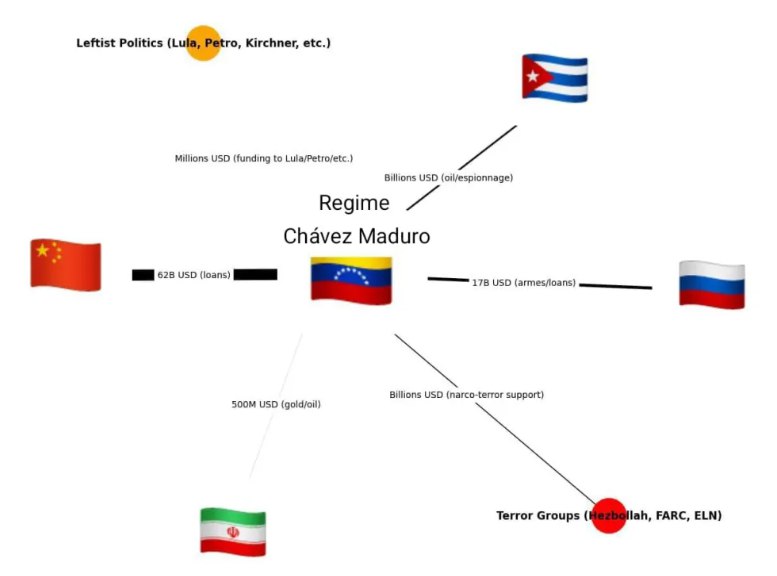
With Russia, opaque agreements with Rosneft saw billions of barrels ceded at discounted prices in exchange for weapons and loans totaling $17 billion (2014–2025), allowing Moscow to control 40–50% of Venezuela’s oil production.
Following Maduro’s arrest, Russia now faces massive losses, with key assets frozen.
(CEPA)
These deals—criticized for their opacity by the Center for Strategic and International Studies (CSIS)—strengthened Russian influence in Latin America while emptying Caracas’s coffers.
(CSIS)
Iran, a key ally through the Quds Force and Hezbollah, exchanged gasoline for laundered gold to circumvent sanctions.
In 2020, Tehran supplied fuel additives and technicians in exchange for 9 tons of gold worth $500 million, transported aboard Iranian aircraft.
(United Against Nuclear Iran)
These exchanges—documented by Al Jazeera and United Against Nuclear Iran—included Venezuelan jet fuel swapped for gasoline, financing Iranian proxies such as Hezbollah while propping up PDVSA’s failing refineries.
(Iran International)
China injected over $62 billion in opaque loans since 2007, repaid in crude oil at unfavorable rates via the China Development Bank.
These so-called “oil-for-loans” deals trapped Venezuela in unsustainable debt, with little productive investment realized, according to AidData.
Post-Maduro, Beijing is negotiating to safeguard $10–15 billion in assets, but the transition could expose massive corruption.
(Wall Street Journal)
Cuba received up to 100,000 barrels per day (worth billions) in exchange for spies and repression: Havana controls Venezuela’s SEBIN intelligence service through its G2, with thousands of Cuban agents embedded in torture and surveillance operations.
(New York Times)
WikiLeaks cables reveal Cuban operatives’ direct access to Chávez and Maduro.
(BBC)
With Maduro’s fall, Cuba trembles, deprived of vital subsidies.
(Miami Herald)
Billions also flowed through Turkey, Syria, and the United Arab Emirates, financing allied dictators such as Erdoğan and Assad.
Diagram of the Maduro corruption network: flows in billions of USD toward allies and terrorist groups, based on Caraval and UNODC reports.

Watering the Global Left with Billions…
Venezuelan dirty money irrigated a vast political network, financing the radical left via the Foro de São Paulo—a “narco-communist super-cartel” founded in 1990 by Lula and Fidel Castro to “reclaim Latin America lost after the fall of the Berlin Wall.”
Hugo Carvajal, former intelligence chief, testified in 2024–2025 that millions were diverted from PDVSA to Lula (Brazil), Petro (Colombia), Kirchner (Argentina), Morales (Bolivia), Correa (Ecuador), Podemos (€15 million in Spain), and the Five Star Movement (Italy).
(Wall Street Journal)
Carvajal describes the Foro as an alliance between legal parties and narco-guerrillas (FARC/ELN), funded via cocaine (Raúl Reyes’ computers, Interpol 2008: $150,000 from Chávez to Lula in 2002) and oil.
(Interpol)
In Colombia, Petro allegedly received funds via diplomatic suitcases, according to Carvajal.
(The City Paper Bogotá)
These financial infusions enabled the left to flourish, influencing elections and policies at the expense of transparency.
Terrorist Ties: A Hub for Narco-Terrorism Built on Venezuela’s Plunder
Under Maduro, Venezuela became a sanctuary for global terrorism, financed by the $2.7 trillion stolen.
Tareck El Aissami, former vice president of Syrian origin, provided passports to Hezbollah militants to infiltrate Latin America, according to secret files revealed by the New York Times and the DEA.
Indicted in the U.S. for narco-terrorism, El Aissami facilitated networks with Hezbollah to launder cocaine through gold and coltan mines.
Ghazi Nasr al-Din, former Venezuelan diplomat, organized meetings in Syria for narco-terrorist networks and was sanctioned by the U.S. Treasury for laundering tons of cocaine.
The FARC and ELN received weapons and impunity in exchange for cocaine: General Clíver Alcalá Cordones pleaded guilty in the U.S. in 2023 to arming the FARC since 2006.
Iván Márquez, dissident FARC leader, was protected in Venezuela, operating with around 1,700 ELN and ex-FARC fighters on Venezuelan soil.
Colombian cocaine production exploded to 2,664 tons per year in 2023 (UNODC)—22 times the Escobar era—with 24% transiting through Venezuela.

The Cartel of the Suns, composed of senior military officials, uses ports and airports to traffic 300–400 tons per year, generating billions.
Iran’s Quds Force exchanged oil for missiles and terrorist support, with Iranian drone factories established in Venezuela.
These ties transformed Venezuela into a global hub of narco-terrorism, financed by national plunder.
Illegal Gold Trafficking: Looting Reserves and Smuggling Routes.

Beyond oil, illegal gold trafficking emptied the vaults: official BCV reserves fell from 365–400 tons (2011–2013) to 70–80 tons in 2026, with over 300 tons diverted since 2016 to bypass sanctions (including $7.4 billion in sales to Turkey in 2019).
The Orinoco Mining Arc—a 2016 decree opening 112,000 km²—sees 80–90% of gold extracted illegally (over 150 tons per year), controlled by the ELN, ex-FARC, sindicatos, and the Tren de Aragua, generating $2–5 billion annually for the regime.
Environmental impacts include deforestation of over one million hectares, mercury pollution across 500 km of rivers, and extreme violence (~1,000 deaths per year in mining zones, including the Yapacana massacres of 2023).
Smuggling routes run through Brazil, Colombia, and Guyana to Dubai—a hub for “dirty gold” importing over $50 billion annually from conflict sources—along with Turkey and India.
A revealing incident: in 2019, an Instagram video of luxury prostitutes in Dubai showed BCV gold bars beneath a glass table, evidence of diversion into criminal circles.
Focus on Brazil: Local Complicity and the Role of Joesley Batista
In Brazil, figures such as Daniel Vorcaro, arrested for 12 billion reais in fraud, laundered $150 million through Venezuelan oil wells.
Raids in January 2026 exposed these links via Banco Master.
Joesley Batista (J&F) met Maduro in November 2025 for secret oil deals (classified for five years) and was tasked by Trump with proposing exile to Turkey—a failed mission leading to Maduro’s arrest.
Batista, involved in a $2.1 billion meat contract in 2015 (brokered by Diosdado Cabello), was fined $256 million by the U.S. DOJ in 2020 for corruption.
Electoral Fraud: Tools of the Dictatorship
Fraud perpetuated the regime. Smartmatic, founded in Venezuela with ties to the PSUV, rigged 14 elections between 2004 and 2017.
In 2017, the company publicly admitted adding one million fictitious votes during the Constituent Assembly election.
Roger Piñate, Smartmatic’s CEO with PSUV ties, and Lord Mark Malloch-Brown were indicted in the Philippines for corruption and money laundering.
Irregularities as early as the 2004 referendum—turnout anomalies exceeding 100% in some precincts—were confirmed by CNN and The New York Times.
Post-Maduro: Updates and Predictions for 2026
Two weeks after Maduro’s arrest, partial releases of political prisoners occurred (41–56 of over 800, including Rocío San Miguel and Enrique Márquez), announced as a “gesture of unity” by Jorge Rodríguez.
Seizures of Russian and Chinese tankers (such as the Marinera and M Sophia, each carrying 2 million barrels) under Operation “Southern Spear” disrupted smuggling.
ExxonMobil is conditioning investment on legal reforms.
Forecasts: chaotic stabilization in February–March with PSUV purges and U.S. deployment; electoral transition in April–May under OAS supervision; uneven reconstruction in June with rising oil output. Right-wing victories in regional elections (Costa Rica, Peru, Colombia, Brazil) will intensify anti-narco pressure.

Conclusion: Justice for a Betrayed, Robbed, Tortured, Censored, and Exiled People—and Lessons for the World
The $2.7 trillion stolen financed an empire of evil: narco-terrorism, electoral fraud via Smartmatic, and ties to Hezbollah, FARC, Iran, and Cuba, while watering the global left with Venezuelan blood.
With nearly 9 million exiles and a country in ruins, justice must be served.
The silence of alternative media on these atrocities—contrasted with their outrage over Gaza—reveals deep ideological bias: a binary anti-Western worldview that idealizes socialist regimes despite their abuses.
As Olavo de Carvalho argued, these Marxist and Eurasian illusions (inspired by Dugin) prioritize utopian collectivism over individual truth.
Venezuela can be reborn by embracing economic freedom, as envisioned by María Corina Machado, 2025 Nobel Peace Prize laureate, who handed her medal to Trump in January 2026, symbolizing an alliance for liberty.

Machado explained her gesture as follows:
“Two hundred years ago, General Lafayette offered Simón Bolívar1 a medal bearing the portrait of President George Washington. Bolívar never parted with it and cherished it throughout his life. Two centuries later, Bolívar’s people return the gesture to the President of the United States—heir to George Washington—by offering him the Nobel Peace Prize medal, in recognition of his decisive commitment to our freedom.”
This gesture draws a powerful historical parallel between U.S. support for South American independence in the 19th century and the current support of the United States (under the Trump administration) for the Venezuelan people’s struggle against the Chavista-Madurista regime.
It symbolizes gratitude, strategic alliance, and continuity of the values of freedom.
- Simón Bolívar (1783–1830), known as El Libertador (“The Liberator”), was a Venezuelan general and statesman who played a decisive role in the independence of several South American countries—Venezuela, Colombia, Ecuador, Peru, and Bolivia—from the Spanish Empire in the early 19th century. He dreamed of a united Latin America and remains an iconic figure of freedom in the region. ↩︎
Vous devez être connecté pour poster un commentaire.