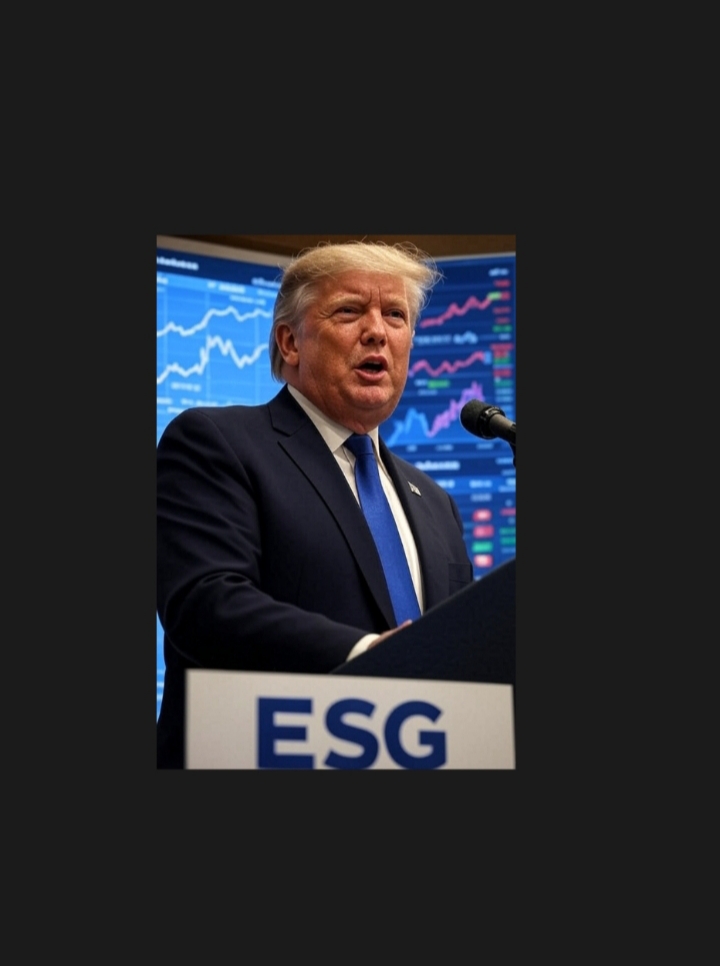
How have ESG policies been used to restructure industries and promote monopolies? And above all, what are the recent changes under the Trump administration in 2025?

ESG policies (Environmental, Social, Governance) are among the most influential in the world of business and investment.

They claim to provide a framework to guide companies toward supposedly responsible and sustainable behaviors. However, beneath this veneer of sustainability, ESG policies primarily serve as a sophisticated vehicle for capital redistribution, orchestrated by major financial institutions to maximize profits, shape markets, and consolidate their dominance.

How have ESG policies been used to channel capital, restructure industries, and foster monopolies?

And, most importantly, what are the recent changes under the Trump administration in 2025 that redirect these dynamics to boost economic growth, middle-class jobs, and reduce inflation in the United States?

ESG: A Tool for Capturing Capital Flows.


ESG policies are promoted as a means for companies to adopt environmentally friendly practices, improve working conditions, or diversify governance.

These standards make companies eligible for ESG funds, attracting more investments and boosting their market valuation. According to McKinsey (in a 2023 study), ESG funds attracted over $2.5 trillion in global investments in 2022. [https://www.mckinsey.com/business-functions/strategy-and-corporate-finance/our-insights/the-net-zero-transition-what-it-would-cost-what-it-could-bring]

This financial windfall is directed by giants like BlackRock, Vanguard, and State Street, which create ESG funds or green bonds to appeal to institutional and individual investors.

However, this system is not neutral, as financial institutions directly influence markets. BlackRock, managing over $12.5 trillion in assets in 2025, plays a central role in this redistribution. Its CEO, Larry Fink, has publicly defended ESG integration, asserting that “shareholder capitalism must evolve into responsible capitalism.”

Yet, ESG funds often carry high management fees, ranging from 0.8% to 1.5% annually, compared to 0.5% for traditional index funds, according to the « Financial Times » (2023). [https://www.ft.com/content/6b2f1a32-7e7e-4a0b-8f1b-7c7e1a1e2f3e] Additionally, the capital appreciation of ESG-compliant companies generates colossal profits for large financial institutions that buy and sell them.

Long-Term Influence on Market Structures.


Beyond immediate profits, ESG policies are tools for major institutions to shape market structures to their advantage.

Controlling capital flows toward ESG-compliant companies allows them to influence corporate behavior and regulations.

A recent example is the European Union’s SFDR regulation, introduced in 2021, which requires funds to disclose their ESG impact. [https://www.esma.europa.eu/policy-rules/sustainable-finance/sustainable-finance-disclosure-regulation-sfdr] Such legislation disadvantages non-compliant companies while favoring those aligned with ESG criteria.

This enables major financial institutions to reshape entire industries, such as renewable energy or electric vehicles.

Notably, companies like Tesla saw their valuation soar, reaching over $1 trillion in 2021.

This dynamic contributes to industry consolidation and the creation of monopolies.

Industry Consolidation and Monopolies.


An insidious effect of ESG policies is their role in industry consolidation. Small businesses often cannot afford ESG compliance costs (up to 10% of their revenue, according to the « Harvard Business Review », 2022), marginalizing them against large corporations backed by major financial institutions. [https://hbr.org/2022/03/the-cost-of-esg-compliance-for-small-businesses]

This disparity creates barriers to entry, forcing small businesses to merge or exit the market. In the renewable energy sector, mergers and acquisitions reached $500 billion in 2023, according to BloombergNEF. [https://about.bnef.com/blog/renewable-energy-deals-hit-record-500-billion-in-2023/]

These transactions, often orchestrated by large financial institutions, reinforce the dominance of big corporations and eliminate competition.

ESG: Exploit, Siphon, Grab.


Far from being a mere sustainability tool, ESG can be cynically summarized as “Exploit, Siphon, Grab.”

Large financiële institutions, leveraging the narrative of a more responsible world, manipulate capital flows to maximize profits and appropriate industries through strategic regulations and consolidations tied to this narrative. As economist Thomas Sowell aptly noted, “Good intentions do not guarantee good results.”

2025 Update: ESG Rollback Under Trump.


Since Donald Trump’s inauguration in January 2025, ESG policies have faced a significant rollback in the United States.

A key development was BlackRock’s withdrawal from the « Net Zero Asset Managers » (NZAM) initiative, which aimed for carbon neutrality by 2050.

Other institutions, such as JPMorgan Chase, followed suit amid pressure from Republicans, who accused major financial institutions of promoting “woke” policies at the expense of economic interests.

A 2024 lawsuit from Texas and 12 Republican-led states accused BlackRock, Vanguard, and State Street of violating antitrust laws by favoring ESG, ultimately raising energy prices. BlackRock also reduced support for climate proposals, voting against 93% of them during the 2022-2023 season.

The Trump administration has prioritized deregulation and support for traditional industries, such as oil and gas, while limiting tax credits for electric vehicles under the « Inflation Reduction Act » (IRA). [https://www.whitehouse.gov/briefing-room/presidential-actions/2025/01/20/executive-order-on-unleashing-american-energy/]

This shift has driven short-term economic growth, with real GDP rising by 2.3% in Q2 2025 after a 0.5% contraction in Q1. Job creation accelerated, with 671,000 net jobs created between January and May 2025, particularly in the oil and gas sectors, benefiting states like Texas.

Increased energy production has stabilized prices in the short term, helping curb inflation.

(https://www.whitehouse.gov/articles/2025/07/economic-growth-shatters-expectations-as-president-trump-fuels-americas-golden-age/)

However, this anti-ESG pivot could hinder innovation in renewable energy, where 300,000 jobs were created between 2022 and 2024 due to the IRA.

(https://www.americanprogress.org/article/trump-is-sending-the-economy-in-the-wrong-direction/)

Conclusion: A Global Strategic Shift.

ESG policies have increased profits for major financial institutions while restructuring markets and consolidating monopolies.

Under the Trump administration in 2025, the ESG rollback, exemplified by BlackRock’s exit from NZAM, reflects a prioritization of growth and jobs in traditional sectors.

These policies have begun to stimulate the economy and reduce inflation in the short term.

For sustained benefits, the administration must balance deregulation with support for innovation while managing inflationary risks tied to tariffs. (https://www.financierworldwide.com/trump-and-esg-the-outlook-for-2025)