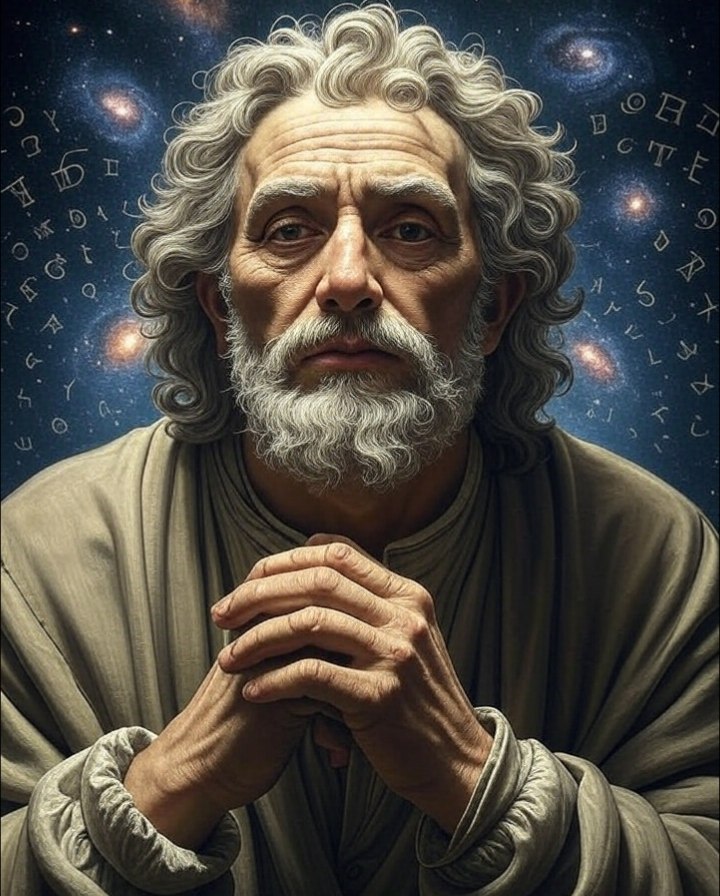
What is the distortion in the way thought connects with reality? And how does this distortion, also called cognitive dissonance, constitute a philosophical break in the history of thought? 

Cognitive dissonance, the intellectual unease born from the gap between theoretical constructs and lived experience, serves as a guiding thread to understand the evolution of Western thought. 

This phenomenon is far from trivial, as it reveals a progressive fracture between man and the cosmos, between the thinker and the reality of which he is an integral part. 

Below, we will explore the origins and implications of this dissonance, tracing its emergence in the history of philosophy and its consequences for how humanity conceives reality. 

Through an analysis of the major stages of this break—from Antiquity to Modernity—we will seek to understand how the philosopher, from a humble observer of the cosmos, transformed into a self-proclaimed « inspector of universal science, » and what this implies for our relationship with truth. 

I. Cognitive dissonance: a definition. 

In the philosophical context discussed here, cognitive dissonance can be defined as the gap between the theoretical framework developed by an individual and the lived reality in which they are immersed. 

This gap does not stem from mere error or intellectual dishonesty but from a structural distortion in the way thought aligns with reality.

In other words, cognitive dissonance arises when the thinker believes they can stand outside reality to observe it objectively, like a detached spectator, while remaining inescapably embedded in the cosmos they claim to judge. 

In Antiquity and the Middle Ages, philosophers from Aristotle to St. Thomas Aquinas maintained a relationship of humility toward reality.

They recognized themselves as part of a larger cosmic order, a whole from which they could not extricate themselves. 

Their reflection was rooted in a tradition of cumulative knowledge, where each thinker modestly contributed to a chain of understanding, aware of their limitations. Aristotle, for instance, asserted that all knowledge derives from prior knowledge, forming a continuity in which the individual is but a link. 

This stance, marked by docility in the face of reality’s complexity, contrasted sharply with the attitude that would emerge at the dawn of modernity. 

II. The first signs of the break: William of Ockham and empiricism. 

One of the earliest signs of this break appears with William of Ockham in the 14th century.

Ockham posited that the reality accessible to our experience—what we can observe and verify—constitutes the measure of what is true. 

This idea, appealing in its simplicity, rests on an illusion: empiricism, while claiming to stick to the facts, can only grasp a tiny fraction of reality. 

Reality, in its depth and complexity, far exceeds the limits of human observation. By proclaiming the universality of empiricism, Ockham introduces a « scotoma« —a blind spot in the visual field or, metaphorically, a gap in perception or understanding. 

This blind spot prevents him from recognizing the inherent biases in his method.

By ignoring the richness of the cosmos, of which man is only a part, Ockham paves the way for a reductive approach, where truth is limited to what can be measured or tested. 

This attitude, though rigorous in its own way, marks the beginning of a distortion: the thinker starts to see themselves as an external observer, capable of judging reality as a whole, forgetting that they are themselves immersed in that reality. 

III. Descartes and the illusion of universal doubt.

Cognitive dissonance intensifies with the advent of modernity, particularly with René Descartes in the 17th century.

In his « Meditations on First Philosophy« , Descartes proposes a radical method: to doubt everything, suspend all certainty to rebuild knowledge on supposedly unshakable foundations. 

This « methodical doubt » aims to place the philosopher outside reality, as if they could observe the universe from a divine, detached position, free from all contingency. 

In reality, this endeavor is doomed to fail. Descartes, while claiming to doubt everything, relies on implicit certainties he never questions.

His method, far from being neutral, is steeped in cultural, historical, and personal presuppositions. 

This gap between what Descartes claims to do—a universal questioning—and what he actually does—reconstructing knowledge from unexamined premises—perfectly illustrates cognitive dissonance. 

The philosopher believes they can extricate themselves from reality, but they remain trapped within their own mental frameworks, unable to recognize them as such. 

This posture, characteristic of modernity, widens the fracture between the thinker and the cosmos.

Where ancient philosophers accepted the primacy of reality over their theories, modern thinkers claim the right to subject reality to their own criteria of truth. 

This attitude, though driven by a sincere quest for certainty, engenders a form of intellectual arrogance that seeks to reduce the infinitude of reality to simplified theoretical models. 

IV. The consequences of dissonance: a war against reality.

Cognitive dissonance, by taking root in Western thought, leads to a veritable war against the complexity of reality.

Modern theories, whether grand philosophical systems or reductive scientific models, tend to isolate a part of reality and treat it as a comprehensive explanation. 

This approach, while productive in some fields, leads to intellectual excesses when the thinker believes their all-encompassing model represents ultimate truth. 

A striking example is theories that claim to grasp the « global meaning » of human history.

Whether through Hegelian, Marxist, or evolutionary perspectives, these theories assert that history follows a linear trajectory toward an ultimate goal. 

Yet, as empirical experience itself highlights, we are immersed in the flow of time, with no access to its beginning or end.

Claiming to determine the « final meaning » of history amounts to creating a world in the image of our own presuppositions, a delusion that ignores the complexity of reality. 

This attitude reflects a loss of the humility that characterized ancient thinkers. Aristotle, for example, recognized that reality held authority over thought: the philosopher must submit to reality, not the other way around. 

St. Thomas Aquinas, similarly, approached the cosmos with intellectual docility, aware that truth exceeds the capacities of the human mind.

In contrast, modernity, relying on self-proclaimed empiricism or rationality, has often succumbed to the temptation to reduce reality to simplistic frameworks, at the expense of its infinite richness. 

V. Intellectual arrogance and its limits. 

This cognitive dissonance, far from being a mere historical accident, reveals a form of intellectual arrogance manifested in the idea that certain truths are unworthy of consideration because they do not meet modern criteria of scientificity or rationality. 

This attitude, embodied, for example, in 19th-century positivism, dismisses any form of knowledge that cannot be validated by empirical experience or formal logic. 

Yet, as Aristotle already emphasized, human knowledge rests on a tradition, an inheritance of understanding that cannot be entirely subjected to empirical testing. 

Empiricism, though presented as a rigorous method, is inherently limited by the constraints of human experience.

We can only observe a tiny fraction of reality, and the rest relies on traditions, consensus, or, worse, fleeting intellectual trends. 

By ignoring this reality, the modern thinker traps themselves in an illusion of mastery, believing they can judge the universe from an external position.

As St. Paul said, « In Him we live and move and have our being« : we are immersed in the cosmos, and any attempt to step outside it to judge it is doomed to fail. 

VI. Toward a reconciliation with reality. 

Faced with this cognitive dissonance, the question arises: how can we reconnect with a thought that respects the complexity of reality? The answer may lie in returning to the humility of the ancients. 

This does not mean rejecting the achievements of modernity but recognizing the limits of our intellectual tools. 

For philosophy to become fruitful again, it must accept that reality is vaster than our theories and that truth cannot be reduced to what we can measure or prove. 

Such an approach involves rehabilitating the notion of tradition as a living chain of knowledge linking the past to the present. It also requires constant vigilance against the biases that push us to simplify reality, whether through empiricism, rationalism, or any other ideology. 

Finally, it calls for a form of intellectual docility, a willingness to learn from the cosmos rather than subjecting it to our preconceived frameworks. 

Conclusions

Cognitive dissonance, as manifested in the history of Western thought, is a symptom of a profound rupture between man and reality.

From William of Ockham to Descartes, through the grand modern theories, the philosopher has gradually lost sight of their condition as a creature immersed in the cosmos. 

This illusion of exteriority, while enabling undeniable advances, has also engendered a form of intellectual arrogance, where the thinker claims to reduce the infinitude of reality to their own categories. 

To overcome this dissonance, we must rediscover the humility of the ancients—not to reject modernity but to enrich our relationship with truth.

By acknowledging that we are part of a cosmos that surpasses us, we can hope to reconnect with a thought more faithful to reality, one that accepts its limits while opening itself to the infinite complexity of the real.