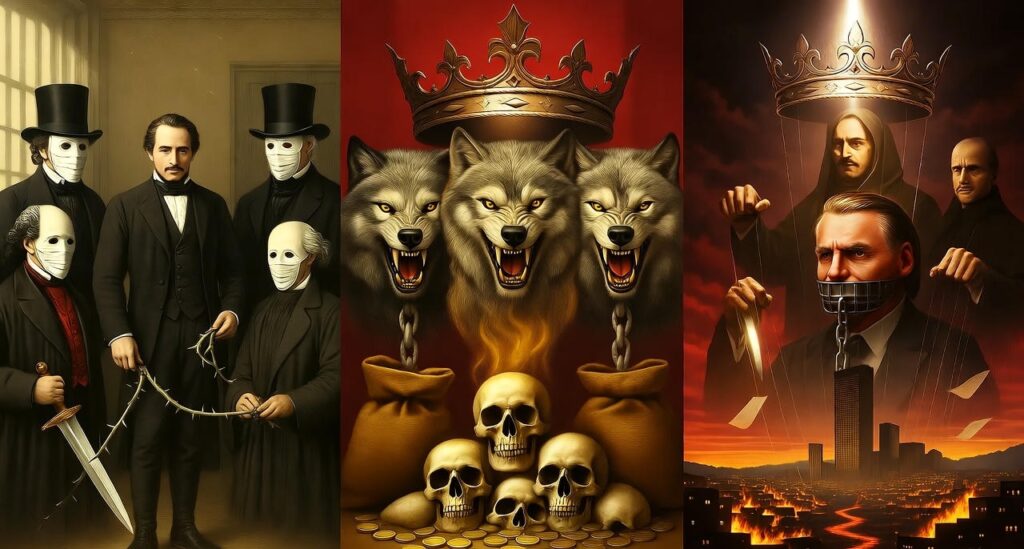
The Oligarchic Legacy: From the Paulista Burschenschaft to the Judicial Persecution of Bolsonaro.

Introduction: The Phantom of the Elite That Never Dies.

At the heart of Brazilian history, there exists an invisible lineage of power.

That lineage intertwines like the roots of a centuries-old tree, nourished by the fertile soil of coffee and watered by the blood of suppressed popular revolts.

This oligarchic elite, born in the secret salons of the Paulista Burschenschaft and forged under the governments of Prudente de Moraes, Campos Sales, and Rodrigues Alves, is not a mere relic of the past. It throbs in the present, adapting like a virus to new hosts: the judiciary, the media, and the economic establishment.

Today, in October 2025, this same « völkisch » fraternity—tribal, exclusionary, and voracious—has united in a ruthless hunt against Jair Bolsonaro, the former president who dared to challenge its monopoly.

Sentenced to 27 years in prison for an alleged « coup plot, » Bolsonaro is not just a man; he is the symbol of an existential threat to this elite that has commanded Brazil for over a century, destroying it in the name of « order. »

This article traces this dark genealogy, revealing how the coffee barons of yesteryear have metamorphosed into lords of the STF and the banks, perpetuating a cycle of domination from the Old Republic to the Lula era.

The Paulista Burschenschaft: The Cradle of the Elite Coup d’État.

It all began in the 1830s, when the German professor Julius Frank founded the Paulista Burschenschaft—or simply « Bucha »—a secret society inspired by the post-Napoleonic liberal student corporations of Germany.

Bringing together jurists, entrepreneurs, and politicians from the São Paulo Law School, this fraternity adopted initiation rituals, oaths of secrecy, and republican rhetoric that masked class interests.

Far from being a popular movement, the B.P. was a network of influence for the Paulista coffee elite, which saw the monarchy as an obstacle to its ascent.

It was from there that the coup d’état of November 15, 1889, was born: a conspiracy between Paulista liberals, disgruntled military men, and oligarchs that proclaimed the Republic without any support from the masses.

The people exploited in the coffee plantations, were mere spectators of a transition that exchanged the empire for an even more exclusionary regime, where census-based and fraudulent voting guaranteed the control of the rural elites.

This golpista articulation was not accidental.

The « buchas »—like Prudente de Moraes and his allies—cultivated a « völkisch » identity, a term evoking German tribal nationalism, but here adapted to a provincial and racist vision: Brazil as an extension of the Paulista latifundium, where progress meant coffee exports and European immigration for the « whitening » of the nation.

The abolition of slavery in 1888, without land reform, left millions of former slaves adrift, while the elite celebrated a « freedom » that benefited only itself.

The 1889 coup d’état was therefore not a democratic revolution, but an oligarchic self-coup, whose scars—abyssal inequality and political instability—persist to this day.

The Macroeconomic Context of the Old Republic: Dependency and Coronelismo.

The Old Republic (1889-1930) inherited from the monarchy a monocultural economy, with coffee representing more than 50% of exports.

But the new regime, unstable from the start, immediately faced the Encilhamento crisis (1890-1891): a speculative bubble that generated galloping inflation, bankruptcies, and external debt. International coffee prices plummeted, forcing Brazil to take out loans like the 1898 Funding Loan, negotiated with English banks.

This external dependency fostered « coronelismo »: rural caciques manipulated elections with the « vote de cabresto, » controlling the illiterate masses in exchange for crumbs.

The « café-com-leite » policy—alternation of power between São Paulo (coffee) and Minas Gerais (milk and minerals)—crystallized this domination, excluding the North, the Northeast, and the emerging urban classes.

Economically, the period was one of stagnation for the masses: while the coffee barons accumulated fortunes, illiteracy hovered around 70%, and revolts like Canudos (1896-1897) were crushed as « fanatical barbarism. »

The 1891 Constitution, liberal on paper, expanded census voting, benefiting only 1% of the population.

This macroeconomic structure was no accident; it was the foundation of an elite that saw the state as an extension of its plantations, prioritizing exports over industrialization or social inclusion.

It is the DNA of this dependency that explains Brazil’s current fragility: a country exporting raw materials, with a Gini index above 0.5, where agribusiness—the direct heir of the coffee growers—dictates policies against land reforms.

Prudente de Moraes, Campos Sales, and Rodrigues Alves: « Völkisch » Rather Than Gentlemen.

Romanticized as stabilizers of the Republic, Prudente de Moraes (1894-1898), Campos Sales (1898-1902), and Rodrigues Alves (1902-1906) were in reality the architects of an oligarchic authoritarianism.

All Paulistas, coffee growers, and « buchas, » they embodied the « völkisch »: a tribal loyalty to the coffee fraternity above any inclusive national project.

Prudente, the first civilian president after the turbulent « Sword Republic » (Deodoro and Floriano), is celebrated for having restored order.

But his « order » was repression: massacres at Canudos, where 20,000 sertanejos were exterminated, and the fomentation of coronelismo through the « policy of governors, » which exchanged federal support for electoral frauds.

As an oligarch, he expanded census voting, excluding 90% of Brazilians, and used the army to crush workers’ strikes.

Far from being a hero, Prudente was the völkisch guardian of the B.P., seeing the people as a threat to Paulista hegemony.

Campos Sales deepened the rollback. His « Policy of Governors » centralized power among the caciques, guaranteeing frauds like the « vote de cabresto. »

Economically, the Funding Loan stabilized finances but imposed austerity that cut social spending, benefiting English creditors and coffee growers.

His Finance Minister, Joaquim Murtinho, prioritized coffee over the people, ignoring peasant revolts.

Campos was the epitome of tribalism: defender of the Paulista elite, which saw the nation as its private property.

Rodrigues Alves continued the cycle with urban reforms in Rio—the « New Rio » of Pereira Passos—but the Vaccine Revolt (1904) erupted against coercive measures that modernized the capital for exports, while the interior rotted in feudalism.

He encouraged European immigration for cheap labor in the plantations, strengthening the PRP (Partido Republicano Paulista), which controlled 25% of voters.

His government was oligarchic cynicism: cosmetic progress for the elite, inequality for the masses.

This triad was not made up of « gentlemen »; they were exclusionary völkisch, who transformed the Republic into a « republic of coronels, » prioritizing coffee stability over democracy.

The Genesis of the Oligarchic Elite: From Coffee to Modern Agribusiness.

By institutionalizing café-com-leite since 1894, Prudente, Campos, and Alves created an endogamous elite, with family ties that transcend regimes.

Their descendants—families like the Matarazzo and the Prado—have evolved toward agribusiness, controlling land (46% of the national territory), banks, and parties like the PSDB and the MDB.

This legacy explains underdevelopment: external dependency, income concentration (the richest 1% holds 28% of wealth), and clientelism, the metamorphosis of coronelismo into a ruralist lobby.

Coups d’état like that of 1930 (deposition of Washington Luís, a Paulista), 1964, and the 2016 impeachment echo 1889: elites overthrow popular leaders to restore « balance. »

This structure has destroyed Brazil: frustrated industrialization, chronic external debt, and inequalities that fuel instability.

Up to 2025, agribusiness—the heir of the barons—blocks reforms, perpetuating a völkisch cycle where the people are the eternal losers.

The Elite United Against Bolsonaro: Persecution as Historical Continuity.

Now, in 2025, this elite—now « judicialized » and media-driven—unites to destroy Bolsonaro, the outsider who broke the monopoly in 2018.

Sentenced to 27 years and 3 months in closed regime on September 11, 2025, for « coup plotting » after the 2022 elections, Bolsonaro is the victim of a hunt that recalls the Canudos massacres: selective, brutal, and justified as « defense of democracy. »

The STF, under Alexandre de Moraes, imposed precautionary measures in July 2025—house arrest, electronic bracelet, and communication ban—based on delations from ex-aides and selective leaks. The PGR, aligned with Lulism, detailed « evidence » that Bolsonarists call a farce, dismantling the thesis of political persecution.

But for supporters, that’s precisely it: a PF operation on July 18, 2025, against Bolsonaro and his allies, exposes judicial collapse, with restrictions without formal charges.

This union of the Paulista elite—tucanos, MDB, and economic establishment—against Bolsonaro echoes the historical völkisch.

Temer, ex-president and tucano figure, praises Moraes as « unyielding » and calls Trump’s sanctions (tariffs on steel and aluminum in August 2025) an « error, » revealing the elite’s terror of economic risk.

Doria, ex-São Paulo governor and Bolsonarist rival, is seen as an indirect mentor, with the « metacapitalist elite » behind the creature Moraes. José Dirceu, PTist, admits that the right has embraced Tarcísio de Freitas (São Paulo governor) for 2026, marginalizing Bolsonaro.

The conviction, retroactive to 2019, aims to render him ineligible, with Eduardo Bolsonaro exiled in the United States.

On social media, the narrative is clear: Bolsonaro « opened the people’s eyes to the oligarchic kleptocracy, » now allied with « Lula’s communism. »

X posts denounce 68 days of « illegal prison, » with Charlie Kirk exposing the STF’s « judicial coup » as totalitarian.

The financial elite, represented by Globo and Estadão, ignores U.S. sanctions, feigning normality while exports suffer. The heirs of the coffee growers—ruralists in Congress—support indirectly, via blocking amnesty.

Eduardo Bolsonaro demands amnesty as the « only remedy, » warning that without it, the « temperature » will explode.

This persecution is not isolated; it is continuity.

As Prudente crushed Canudos to protect coffee, Moraes « buries alive » Bolsonaro to safeguard the system.

The family suffers: Michelle weeps, the 14-year-old daughter is devastated, while the 70-year-old septuagenarian, stitched up after assassination attempts, withers away. Trump’s sanctions, via the Magnitsky Act, press, but the elite resists, prioritizing its Paulista bunker.

Conclusion: Break the Cycle or Perish.

From the Bucha to Bolsonaro’s bracelet, the oligarchic elite has woven a web that strangles Brazil.

Prudente, Campos, and Alves planted the seeds; their heirs reap power, destroying nations in the name of the tribe.

Bolsonaro, with his flaws, represented the rupture—and for that, the hunt.

To break the cycle, amnesty and judicial reform are needed, or the völkisch will triumph, perpetuating destruction.

The people, awakened in 2018, must choose: submission or peaceful revolution. History will judge the elites.