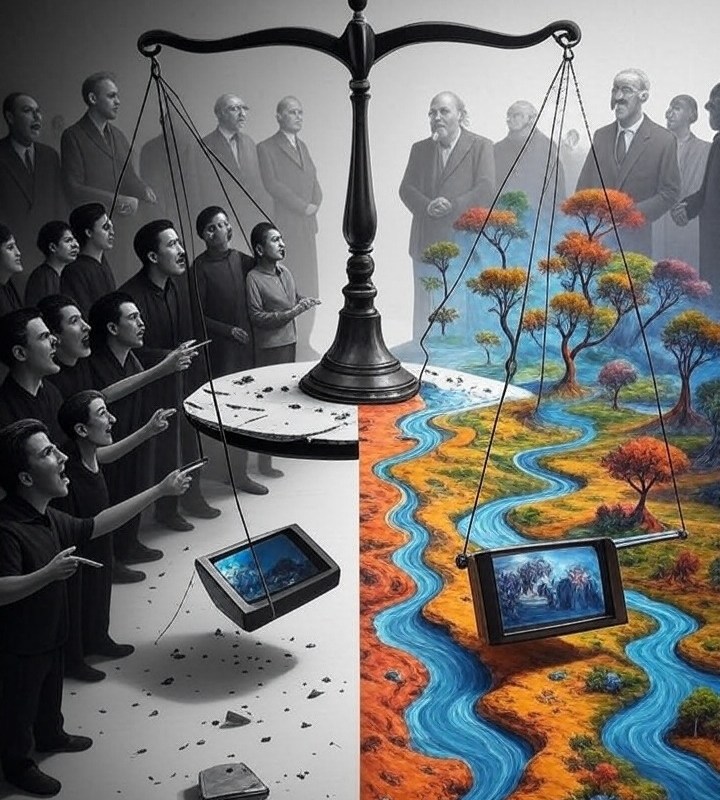
What is « polarization, » a central term in our analysis?
Polarization, or more precisely extreme ideological division, refers to the various processes by which the opinions, beliefs, or attitudes of individuals or groups split into two opposing and radical poles, pushing moderate and central positions aside to promote these ideological extremes. (https://www.populismstudies.org/Vocabulary/political-polarization/)
This definition, drawn from political science discussions, highlights how this extreme division transforms debates into binary confrontations, where compromise becomes rare and mutual understanding difficult.
A study published in 2022 in « Social Psychological and Personality Science« , titled « When history seems to repeat itself: exposure to perceived lessons from the past influences predictions about current political events, » reveals that repeated exposure to extreme historical analogies can alter subjects’ political predictions and judgments, with a particularly pronounced effect among those with limited knowledge of the subject, reaching an effect coefficient of -0.24, or roughly 25% increased influence for less-informed individuals. (https://pmc.ncbi.nlm.nih.gov/articles/PMC8932355/)
This research, conducted by Djouaria Ghilani and her collaborators, demonstrates how simplified comparisons—such as those between historical events and contemporary crises—can distort reality, pushing individuals toward divided, extreme views rather than nuanced ones.
This study perfectly illustrates the phenomenon of judgment alteration through extreme analogies. It sheds light on a broader phenomenon: the extreme ideological division created by the media, certain academics, and influencers, who reinforce clichés, caricatures, and intellectual shortcuts.
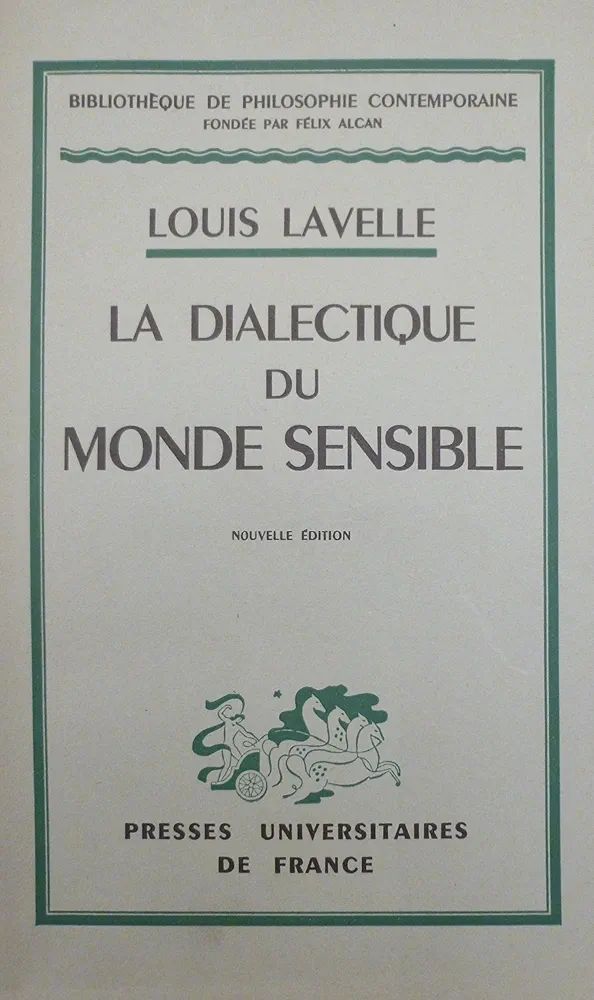
Instead of reflecting the « density of reality« —an expression dear to the French philosopher Louis Lavelle, which refers to the infinite and multidimensional richness of existence, where every event is woven with multiple layers and contradictions, as he discusses in « The Dialectic of the Sensible World » when noting that analysis can never exhaust reality—these entities promote a binary, black-or-white vision that obscures true complexity.
Under the influence of the media and certain academic activists and influencers, this « density of reality » is flattened into binary caricatures, serving oriented agendas and manipulating collective thought.
Mechanisms of extreme ideological division in the media.
The media, whether mainstream traditional or alternative digital, play a pivotal role in this distortion.
Noam Chomsky, a linguist and sharp critic of media power, has extensively analyzed how the media manufacture consent.
In his book « Media Control », he states: « Propaganda is to democracy what the bludgeon is to the totalitarian state. »
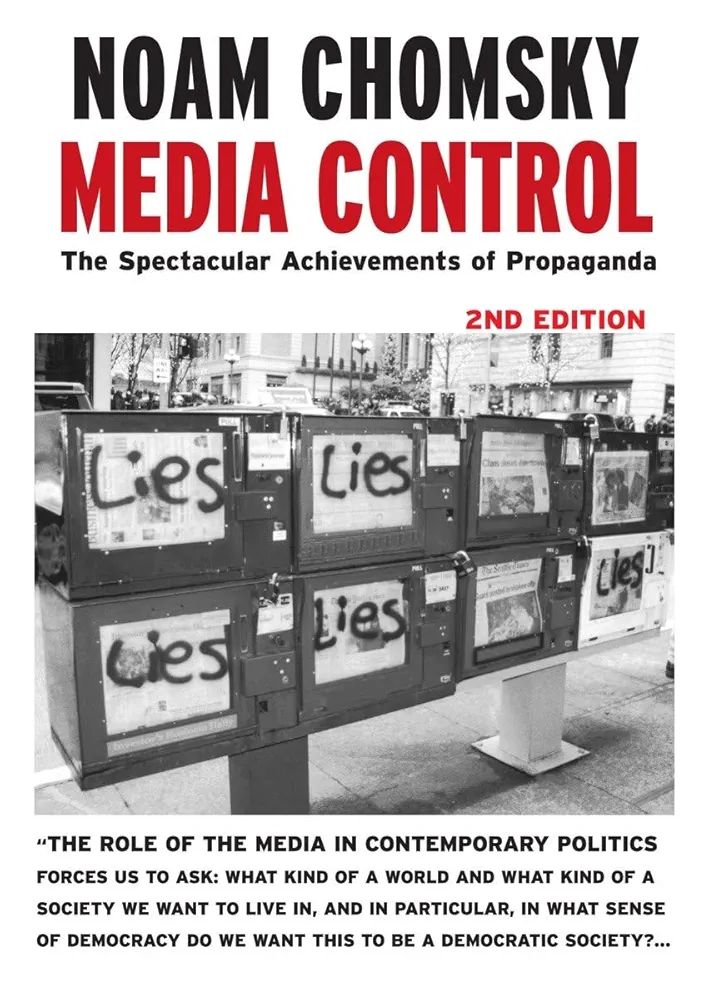
Chomsky explains that the media limit the spectrum of acceptable opinions, allowing lively debate but confined to extreme poles, thus reinforcing this extreme ideological division where opinions radicalize and fiercely oppose each other. For example, in debates on climate change or migration, positions are reduced to « catastrophists » versus « denialists, » ignoring scientific and human nuances.
This binary framing fosters clichés: migrants become either « invaders » or « innocent victims, » without exploring the complex economic or cultural contexts.
Caricatures abound, as seen on social media, where algorithms amplify extreme content to maximize engagement.
A 2023 study on echo chamber effects in short-video platforms shows how these algorithms reinforce pre-existing opinions, creating ideological bubbles where nuance is absent. (https://pmc.ncbi.nlm.nih.gov/articles/PMC10111082/)
The result: a black-and-white worldview where the other is demonized, and measured reflection gives way to uncontrolled emotion.
Universities, supposed bastions of critical thinking, paradoxically contribute to this extreme ideological division. Social psychologist Jonathan Haidt observes in his work on polarization that « academics form political teams that share moral narratives. Once they accept a particular narrative, they become blind to alternative moral worlds. » (https://jonathanhaidt.com/politics/)
On American and European campuses, humanities departments are dominated by progressive ideologies, marginalizing conservative voices and creating a caricature of intellectual diversity.
Haidt notes that this growing division, exacerbated since the 2010s, leads to an increase in hate crimes and social fragmentation, as described in his article « The Polarization Spiral. » (https://www.stern.nyu.edu/experience-stern/faculty-research/the-polarization-spiral)
Clichés and caricatures as tools of manipulation.
Caricaturing and spreading clichés and shortcuts is not innocent, as they serve oriented social manipulation. Hannah Arendt, in « The Origins of Totalitarianism », warns that « in an ever-changing, incomprehensible world, the masses reach a point where they believe everything and nothing at the same time, and think that everything is possible and nothing is true. » (https://philosophybreak.com/articles/hannah-arendt-5-insights-into-totalitarianism/)
Arendt describes how this confusion is created and used to impose binary visions: friend/enemy, pure/impure.
The media and universities replicate this mechanism by fostering extreme ideological division, thus controlling thought. Instead of fostering elaborated reflection, we witness manipulation where chosen directions—often aligned with economic or political interests—are imposed.
Chomsky clearly states that the intelligent way to keep people passive and obedient is to strictly limit the spectrum of acceptable opinions while allowing very lively debate within that spectrum.
Intellectual shortcuts abound, and the media use extreme analogies—comparing a politician to Hitler or a social movement to a revolution—to alter judgment.
As shown in the 2022 study in « Social Psychological and Personality Science« , repeated exposure to extreme historical analogies can alter subjects’ political predictions and judgments, with a particularly marked effect among those with limited knowledge of the subject.
This promotes a vision unfaithful to complexity rather than a nuanced process. Above all, it forces the public to remain within this extreme and caricatured framework, constantly defining it as real to reinforce its anchoring and strength in the collective imagination. Yet, of course, this framework is actually a crude and unhealthy cliché deliberately constructed to steer the public in desired directions.
Louis Lavelle’s « density of reality » as a forgotten antidote.
Twentieth-century philosopher Louis Lavelle offers a refreshing perspective.

In his writings, such as « The Dialectic of the Sensible World« , he describes the « density of reality » as the infinite depth of being, where every moment is saturated with possibilities and contradictions. Reality is not binary; it is dense, plural, and requires measured reflection. Lavelle writes that analysis can never exhaust reality, emphasizing its fullness.
The media, certain academics, and influencers, by promoting binary visions, betray this density, pushing individuals toward oriented directions.
This manipulation controls how people think. In schools and universities, oriented programs often reinforce narratives, training generations to think in binary rather than complex terms.
Social consequences and paths toward plural reflection.
The consequences of this extreme ideological division are severe, leading to increased social fragmentation.
To counter this, we must promote dialectical thinking that embraces nuance.
Arendt reminds us that factual truth can survive distortions, just as Chomsky and Haidt urge us to resist caricatures, clichés, and shortcuts.
In conclusion, this extreme ideological division is not inevitable.
By recognizing manipulation mechanisms and cultivating elaborated reflection, we can restore a plural vision of the world.
As Lavelle says, reality is dense; it is time to explore it in all its depth.
 Deus - Patria - Familia - Libertas
Vous devez être connecté pour poster un commentaire.