Two explosive documents shed new light on a truth that Brazil’s official left has been trying to bury for decades: in 1989, during the first direct presidential election after the dictatorship, the United States and its influential elites already had a clear preference for an “acceptable” left—moderate and aligned with their interests.
That left was the one represented by Luiz Inácio Lula da Silva.The other, that of Leonel Brizola—nationalist, labor-oriented, anti-imperialist, and truly independent—was seen as a danger.
Declassified archives, including a CIA memo and a Brazilian intelligence report, prove this unambiguously.
But these revelations don’t stop at 1989.
Other sources, like the explosive book Thy Will Be Done by Gerard Colby and Charlotte Dennett—which details Nelson Rockefeller’s conquest of the Amazon through evangelism and oil interests—show that the influence of the Rockefellers and the CIA on Brazilian unions goes back much further.
As early as the 1960s-1970s, U.S.-funded training programs by entities linked to the CIA, such as the AIFLD (American Institute for Free Labor Development) and the AFL-CIO, were used to train a generation of “moderate” union leaders.
And Lula, according to direct testimonies, benefited from them right from the start of his career.
Today, in 2026, with Lula back in power for a third term, these revelations take on an even graver dimension: they confirm that the PT and its historic leader have never been the sovereign left they claim to be, but rather a controlled option, funded and promoted by American globalist circles—Rockefeller, Ford Foundation, Council of the Americas, AFL-CIO, and, in the background, the CIA.
The 1989 Crisis: Brazil on the Brink and Elites in Panic.
Let’s recall the context. Brazil was emerging from 21 years of military rule (1964-1985), a regime that, despite its flaws, had at least preserved the country from the communist chaos ravaging Latin America. The “opening” initiated by Geisel and Figueiredo had led to the 1988 Constitution and the direct elections of 1989.
But the country was in economic ruins: hyperinflation nearing 1,000% per year, crushing external debt, stabilization plans collapsing one after another.
Poverty was exploding, strikes were multiplying, and industrial elites were trembling.In this chaos, Leonel Brizola emerged as the natural favorite of the left.
The charismatic governor of Rio, direct heir to Getúlio Vargas and João Goulart, he embodied a national-populist left: defense of Brazilian industrialization, agrarian reform, massive education through CIEPs, and above all, firm anti-imperialism.
Brizola had resisted the 1964 coup with the “chain of legality,” spent 15 years in exile, and returned crowned with a resounding victory in Rio in 1982. For the military and big bosses, he was the man to take down: a “radical” who could nationalize, break with the IMF, and defy Washington.
That’s exactly what the declassified CIA memo reveals.
The CIA Memo: Brizola the Danger, the Army Solicited for a Coup.
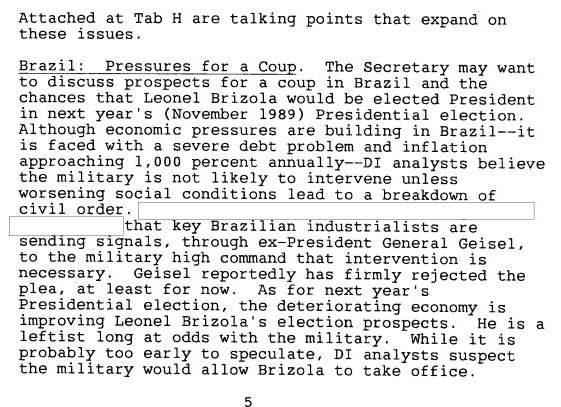
The document, prepared for the U.S. Secretary of State in the late 1980s, is titled “Brazil: Pressures for a Coup.”
It is clear and direct: “Influential Brazilian industrialists are sending signals, via former president General Geisel, to the military high command indicating that intervention is necessary.”
Geisel, according to the CIA, rejects it for now, but the pressure is real.Why this panic?
Because “the deterioration of the economy improves the electoral prospects of Leonel Brizola.” The CIA describes him bluntly: “a leftist in long-standing conflict with the army.”
American analysts estimate that the army won’t intervene without total chaos, and—pay attention—that it “would probably let Brizola take office” rather than risk an unpopular putsch.
But between the lines, the message is clear: Brizola is a problem. He is monitored, feared.
The CIA doesn’t say it wants a coup, but it notes with satisfaction that the army might ultimately tolerate… something else. And that “something else” is precisely what happens: the sudden emergence of a more “reasonable” left alternative.
Lula’s Trip to New York: The Revealing Meetings.
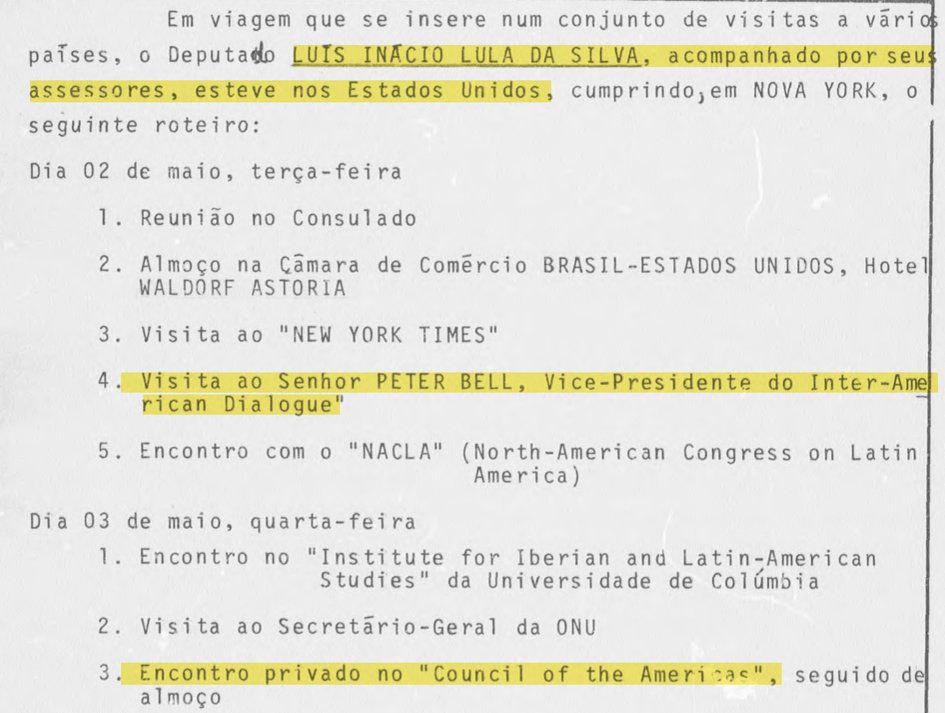
The second document, a 1989 Brazilian intelligence report, is even more revealing. It details a trip by Lula to New York in May 1989, right as the campaign was heating up.
Lula, then a union leader and founder of the PT, meets whom?
Not just anyone: The USA-Brazil Chamber of Commerce, The Council of the Americas (a powerful lobby founded by David Rockefeller) Peter Bell, from the Inter-American Dialogue, heavily funded by the Ford Foundation.
– The Council of the Americas has always defended the interests of American multinationals in Latin America.
– The Ford Foundation, often accused of being an arm of American “soft power,” has funded intellectuals and “moderate” movements for decades to counter radical nationalisms.
These meetings are not insignificant: they serve to present Lula as a responsible leader, ready to negotiate with foreign capital, respect the debt, and not scare the markets.
These contacts show a clear preference: Washington and Wall Street wanted a left that wouldn’t challenge the established order.Brizola, with his sovereignist discourse, was unacceptable.
Lula, pragmatic and open to dialogue with global elites, was the ideal option.
The Deeper Roots: Rockefeller, the CIA, and Lula’s Union Training from the 1970s.
But the story doesn’t start in 1989.
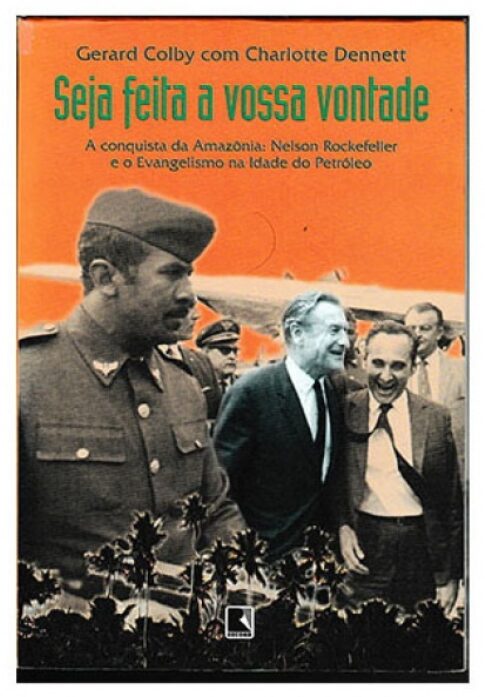
The book Thy Will Be Done (Brazilian edition: Seja feita a vossa vontade), by Gerard Colby and Charlotte Dennett, published in 1995, reveals the extent of the Rockefeller strategy in Brazil.
The book’s cover itself is eloquent: Nelson Rockefeller, smiling alongside a Brazilian military dictator (Emílio Garrastazu Médici), symbolizes decades of collusion between American oil interests, missionary evangelism, and authoritarian regimes to “conquer” the Amazon.
On page 499, the authors document how, as early as 1963, the AIFLD—supported by George Meany, president of the AFL-CIO and ally of Nelson Rockefeller—organized training sessions in the United States for dozens of Brazilian unionists.
These programs, according to the book, had become an “auxiliary arm of the CIA” to infiltrate and moderate labor movements, thus avoiding radicalizations like in Cuba.
The CIA was active in Brazil since 1962, and these trainings served to create a generation of union leaders aligned with American interests.
Now, according to the book Jogo Duro by entrepreneur Mário Garnero (close to the Bushes and an influential intermediary), Lula himself attended these trainings: AFL-CIO courses at Johns Hopkins University in Baltimore, between 1972 and 1973.
Garnero, who has no reason to lie on this point, claims that this marked the international preparation of the young unionist.In 2019, Lula received the prestigious George Meany-Lane Kirkland Human Rights Award from the AFL-CIO—the same George Meany cited in Colby and Dennett’s book as a key ally of the Rockefellers and the CIA.
These elements show that the American “investment” in Lula dates back to his beginnings in the syndicalism of the ABC paulista region.
While Brizola, exiled and a pure resister, represented a sovereignist threat, Lula was trained, from the 1970s, in circuits controlled by the Rockefellers and their anti-communist union networks.
The 1989 Campaign: How Brizola Was Sidelined.
Polls from 1988-1989 placed Brizola far ahead. He embodied the hope of an authentically Brazilian left. But suddenly, two phenomena converged: The media, notably Rede Globo, propelled Fernando Collor, the “marajá hunter,” the liberal right-wing candidate.
Lula advanced rapidly, nibbling away at Brizola’s popular electorate. In the first round: Collor 30.5%, Lula 17.2%, Brizola 16.5%. Only a few tens of thousands of votes separated Lula from Brizola. The latter would denounce electronic fraud—an accusation that, in hindsight, takes on a particular flavor when viewing current debates on voting machines.
In the second round, the elites rallied massively behind Collor to block Lula. But the damage was done: Brizola, the real danger to the system, had been neutralized.
And Lula? He became the undisputed leader of the left for the following decades.
Lula and the Globalists: A Long History of Alignment.
These 1989 documents, supplemented by Colby and Dennett’s book and Garnero’s testimony, are just the beginning. Subsequently, the PT and Lula multiplied ties with the same circles: The Ford Foundation would fund NGOs and intellectuals close to the PT. George Soros, through his foundations, would support causes aligned with the Foro de São Paulo, but always in a “progressive” logic compatible with globalism.
Fernando Henrique Cardoso, before becoming a neoliberal president, frequented the same think tanks. Lula as president (2003-2010) implemented ambitious social policies, certainly, but without ever breaking with the IMF, without massive nationalizations, without a real challenge to American hegemony.
On the contrary: increased integration into the world economy, agreements with multinationals.Today, in 2026, Lula III continues the same line: alignment with the globalist climate agenda, censorship of social networks in partnership with Big Tech, rapprochement with American Democrats.
Meanwhile, true sovereignists—those who defend national industry, the army as guarantor of order—are criminalized.
Brizola, the Great Loser of History.
Leonel Brizola, until his death in 2004, remained a symbol of what a truly independent Brazilian left could have been. He supported Lula in 1994 and 1998 out of pragmatism, but never hid his criticisms of the PT’s sectarianism.
If he had won in 1989, Brazil might have taken another path: more national, less submissive to the dictates of Washington and Wall Street.
Instead, we had Collor (corrupt and impeached), FHC (massive privatizations), then Lula and Dilma, with their Lava Jato scandals, followed by Lula’s return after a politically orchestrated release.
Conclusion: The Documents Speak, History Repeats Itself.
The declassified archives, enriched by Colby and Dennett’s shocking book on the Rockefeller empire and the CIA-AFL-CIO union trainings that Lula benefited from as early as the 1970s, leave no doubt: from its origins, Lula represented the left that the United States could tolerate, train, promote, and fund.
Brizola was the real danger, the one that had to be marginalized.In 2026, these revelations must serve as a warning.
Brazil needs a patriotic right and a truly national left to escape the globalist grip.
As long as Lula and the PT dominate the left, they will remain the “safe” option for those who, from New York to Davos, decide the fate of emerging nations.
It is time to reread history without the filters of the official narrative.
The documents are there. They speak. And they accuse.