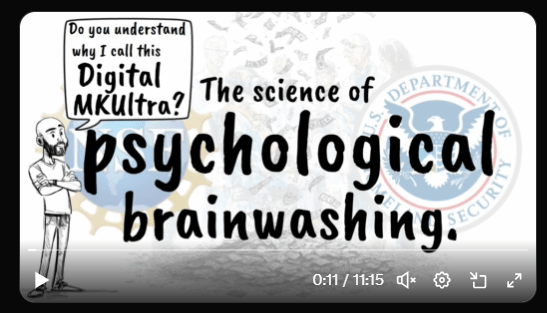
In a riveting address at the Restore Free Speech Conference, Mike Benz, former U.S. State Department official and executive director of the Foundation for Freedom Online, pulled back the curtain on what he terms « Digital MK Ultra« —a modern echo of the infamous CIA mind-control experiments of the mid-20th century.
Benz’s talk, delivered with the urgency of a whistleblower, dissected how U.S. government agencies are channeling taxpayer dollars into university labs to pioneer techniques of psychological brainwashing.
At the heart of his revelations is Dr. Cynthia Miller-Idriss, a prominent academic whose work blurs the lines between education, intelligence, and behavioral manipulation.
Drawing from Benz’s analysis, this article explores the mechanics of this « digital » psyop, its ties to censorship, and its chilling implications for free thought.
The Echoes of MK Ultra in the Digital Age.
Benz invokes MK Ultra not as hyperbole but as a structural parallel.
The original program, run by the CIA from the 1950s to the 1970s, involved dosing unwitting subjects with LSD and other substances at over 60 universities—from Stanford to Berkeley—to engineer behavioral modification.
Today’s version, Benz argues, swaps chemicals for algorithms and videos, targeting populations through social media and « prebunking » campaigns.
Funded by the National Science Foundation (NSF), Department of Homeland Security (DHS), and Department of Education, these efforts aim to « inoculate » minds against « misinformation« —a term Benz contends is selectively applied to dissenting views on everything from vaccines to elections.
Enter Dr. Cynthia Miller-Idriss, a professor at American University’s School of Public Affairs and School of Education.
She directs the Polarization and Extremism Research and Innovation Lab (PERIL), a hub for studying online radicalization.
Her research has secured grants from the NSF, DHS, and Department of Education, funding projects that Benz describes as « the science of censorship » and « psychological brainwashing.«
Miller-Idriss has testified before Congress multiple times, including in 2022 hearings on domestic extremism, where she emphasized that counter-disinformation efforts focus on « teaching people how to think » rather than dictating content.
Yet Benz highlights the irony: her work, he claims, disproportionately targets right-leaning narratives, from Trump’s voter base to Europe’s Alternative for Germany (AfD) party, which advocates exiting the EU and restoring ties with Russia—positions Benz says threaten U.S. foreign policy interests.
Her books, such as « Hate in the Homeland: The New Global Far Right » and « The Extreme Gone Mainstream« , frame far-right extremism as a mainstream threat, often linking it to youth culture and online spaces.
Benz points out her briefings to intelligence agencies, including the CIA, on disinformation tactics—ostensibly to counter threats like AfD’s rise, which could disrupt NATO’s agenda.
In one pointed critique, Benz notes her focus on « stopping Trump, » equating his supporters with « far-right » actors, potentially ensnaring 100 million Americans in the crosshairs of censorship.
The PERIL Lab: A Nexus of Academia and Intelligence.
At PERIL, Miller-Idriss’s team develops tools to « foster community resilience » against extremism, but Benz portrays it as a censorship factory.
A key partner is Google Jigsaw, the tech giant’s « incubator for geopolitical contradictors, » founded by Jared Cohen—a State Department alum who Benz calls « Condi’s party starter » for pioneering social media in CIA-backed regime changes, like the Arab Spring.
Jigsaw’s Perspective API, trained on 2016 election data, was originally designed for countering ISIS propaganda but now scans for « toxic » speech, including anti-vaccine rhetoric.
Benz spotlights a 2022 PERIL-Jigsaw collaboration: a quasi-experimental study testing « attitudinal inoculation videos« on 2,000 unvaccinated adults.
These 30-second clips, styled as psychological « vaccines, » expose viewers to weakened, straw-manned versions of anti-vax arguments—claims like « vaccines are unnatural » or « cause unrelated injuries« —then flood them with counterpoints to build aversion.
The results? Participants showed reduced support for sharing or funding such content, alongside higher willingness to vaccinate.
Benz likens this to A Clockwork Orange: forced viewing to rewire beliefs, measuring not just attitude shifts but suppression of dissent online.
| Key Study Outcomes | Description |
|---|---|
| Recognition of Misinformation Tactics | Viewers better identified « rhetorical strategies » in anti-vax narratives. |
| Reduced Sharing/Support | Lower likelihood to share or financially back misinformation videos. |
| Increased Vaccine Willingness | Higher intent to get COVID-19 shots post-viewing. |
This « prebunking » mirrors vaccine mechanics: a microdose of the « disease » (distorted misinformation) builds antibodies (aversion).
Benz warns it’s a « get out of logic free card« —framed as neutral education but deployed to nudge behavior during crises like vaccine rollouts.
The Codebook: Mapping Dissent for AI Censorship.
Deeper in the weeds, PERIL’s work includes developing « codebooks » of anti-vax rhetoric—lexicons of keywords, phrases, and narratives to script inoculation videos.
Benz draws a direct line to Pentagon-funded AI tools that targeted ISIS slang for removal; now, the same tech sandblasts skeptics.
A 2022 PERIL publication mapped English-language anti-vax propaganda, testing three inoculation videos against it.
On PERIL’s official account, this extends to branding Elon Musk as a « QAnon-adjacent » threat to democracy—contradicting Miller-Idriss’s testimony that her lab avoids policy stances.
Benz ties this to broader censorship hearings, referencing Martin Gurri—a former CIA analyst and author of « The Revolt of the Public« —who testified alongside figures like Matt Taibbi on government-social media collusion.
Democrats, Benz notes, dismissed such claims, even as evidence mounted of « simultaneous not happening and happening » censorship.
Implications: A First Amendment Under Siege.
Benz’s conference talk paints Digital MK Ultra as a web of intelligence agencies, universities, and NGOs experimenting on citizens—your « ancestorship, » as he quips.
Funded by three agencies, it risks economic sabotage: deboosting skeptics’ content to starve creators of revenue, all under First Amendment protections that bar government media favoritism.
As Benz urges, understanding this isn’t paranoia; it’s preparation.
Miller-Idriss’s innovations, while cloaked in anti-extremism rhetoric, could « pre-censor » any belief challenging the status quo.
In an era of AI-driven moderation, the line between inoculation and indoctrination blurs.
Taxpayers deserve transparency: Are we funding resilience or regime change at home?
This article is based on Mike Benz’s keynote at the Restore Free Speech Conference, February 2024.
 Deus - Patria - Familia - Libertas