Summary:
In 1973, facing the oil crisis, visionary Prime Minister Pierre Messmer launched a bold nuclear program that propelled France to the rank of world leader in nuclear energy.
In 2025, nuclear power provides 69% of French electricity (RTE France https://www.rte-france.com/actualites/production-electricite-francaise-atteint-plus-haut-niveau-depuis-5-ans), but European degrowth policies, advocating a reduction in energy consumption, risk triggering a crisis: price increases, shortages, and industrial weakening.
This article traces Messmer’s legacy, analyzes the challenges of 2025, and advocates for a nuclear revival to ensure sovereignty, competitiveness, and a sustainable future.
Pierre Messmer and the 1973 Oil Crisis.
In October 1973, the Yom Kippur War triggered an embargo by the Organization of Petroleum Exporting Countries (OPEC), quadrupling oil prices.
France, dependent on imports for 75% of its energy, saw its economy falter. Energy-intensive industries, households, and national stability were threatened.
In this critical context, Pierre Messmer, then Prime Minister, transformed this crisis into an opportunity.
Born in 1916, Pierre Messmer embodies a bold France. Engaged from 1940 in the Free French Forces, he fought at Bir Hakeim, escaped from the Viet Minh in 1945, and received the Croix de la Libération. Minister of the Armed Forces (1960-1969), he developed the French nuclear deterrent force, defying American pressures.
In 1971, he became Minister for Overseas Territories, then Prime Minister in 1972 under Georges Pompidou.
Faced with the oil crisis, Messmer launched the Messmer Plan in March 1974, a nuclear program aimed at energy independence (French Nuclear Energy Society https://www.sfen.org/rgn/le-plan-messmer-retour-aux-sources-du-parc-electronucleaire-francais/).
The objective was ambitious: build 80 reactors in 15 years, with a capacity of 50,000 MW by 1980, to produce 360 TWh in 1985 and 1,000 TWh in 2000.
The plan relied on pressurized water reactors (PWR), imported from Westinghouse and adapted by Framatome (today Orano).
Standardization of the reactors allowed for rapid construction, at a rate of 6 to 7 units per year, marking an industrial feat.
The Success of the Messmer Plan.
The Messmer Plan made France a world leader in civil nuclear energy.
Between 1977 and 1999, 58 reactors were commissioned, reaching a capacity of 63 GW in 2024.
(Works in Progress https://worksinprogress.co/issue/liberte-egalite-radioactivite/).
Iconic sites, like Fessenheim, Gravelines, Tricastin, and Bugey, became pillars of the energy system.
Financed by international loans totaling 228 billion euros (2010 values, Works in Progress https://worksinprogress.co/issue/liberte-egalite-radioactivite/), the program stimulated the economy and strengthened French sovereignty.
Energy Impacts.
– Energy Independence:
The rate rose from 26% in 1973 to 51% in 2021, stabilized around 50% in 2025 (Sustainable Development Statistics https://www.statistiques.developpement-durable.gouv.fr/edition-numerique/bilan-energetique/fr/10-21-le-taux-dindependance-energetique).
– Electricity Production:
In 2024, nuclear produced 361 TWh, or 69% of the energy mix, followed by hydroelectric (13%) and wind (9%).
(RTE France https://www.rte-france.com/actualites/production-electricite-francaise-atteint-plus-haut-niveau-depuis-5-ans).
Estimates for 2025-2026 forecast 350-370 TWh (EDF https://www.edf.fr/groupe-edf/espaces-dedies/journalistes/tous-les-communiques-de-presse/estimation-de-production-nucleaire-en-france-pour-2025-2026-et-2027).
Economic Impacts.
The program created over 100,000 jobs, boosted EDF and Framatome, and promoted technological exports.
The average construction cost, about 1.17 million euros per MW (Works in Progress https://worksinprogress.co/issue/liberte-egalite-radioactivite/), remains competitive compared to intermittent renewables.
Between 1974 and 2000, it saved hundreds of billions of euros in oil imports.Program Structure.
The plan was deployed in standardized series:
– CP0: 6 units (1977-1979).
– CP1: 18 units (1980-1985).
– CP2: 10 units (1983-1988).
– P4/P’4: 20 units of 1,300 MW (1984-1994).
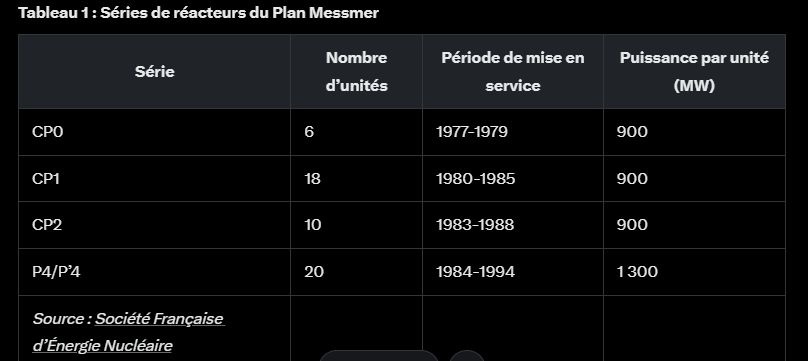
Source: French Nuclear Energy Society https://www.sfen.org/rgn/le-plan-messmer-retour-aux-sources-du-parc-electronucleaire-francais/)
Graph 1: Evolution of Installed Nuclear Capacity (1977-2024).
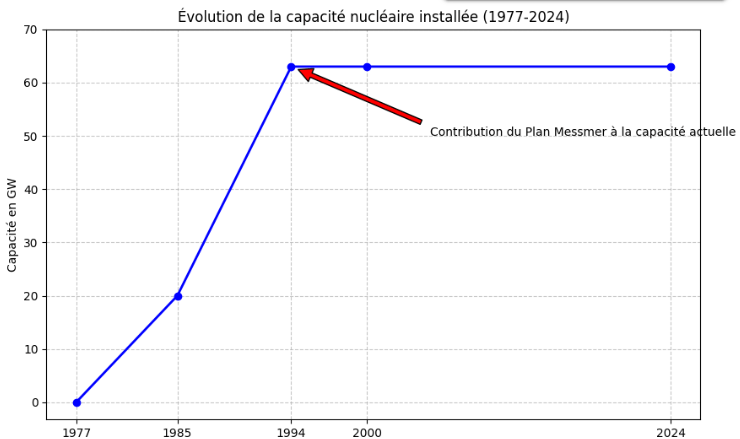
Description: A line graph showing the growth of installed nuclear capacity in France from 1977 (start of the Messmer Plan) to 2024.
The x-axis represents the years (1977, 1985, 1994, 2000, 2024), and the y-axis the capacity in GW (from 0 to 70 GW).
The curve rises rapidly from 1977 to 1994 (construction of the 58 reactors), then stabilizes around 63 GW until 2024.
An annotation highlights the contribution of the Messmer Plan to the current capacity.
Data: Works in Progress https://worksinprogress.co/issue/liberte-egalite-radioactivite/).
The Messmer Plan in Figures.
– Reactors Built:
58 units (1977-1999)
(French Nuclear Energy Society https://www.sfen.org/rgn/le-plan-messmer-retour-aux-sources-du-parc-electronucleaire-francais/)).
– Installed Capacity:
63 GW in 2024.
– Investments:
96 billion euros for construction, 228 billion total (2010 values)
(Works in Progress https://worksinprogress.co/issue/liberte-egalite-radioactivite/).
– 2024 Production:
361 TWh
(Zonebourse https://www.zonebourse.com/actualite-bourse/production-da-electricite-nucleaire-en-baisse-mercredi-en-france-ce7c5ed3de8afe2d).
– Jobs:
100,000 created.
– Environmental Impact:
Reduction of 20-30% in CO2 emissions.
2025: The Challenges of Degrowth and New Needs.
In 2025, Europe faces a potential energy crisis, exacerbated by degrowth policies advocating a voluntary reduction in energy consumption.
These policies, although motivated by ecological goals, risk weakening the economy and social stability, while energy needs are growing.
The Risks of Degrowth.
– Economic Contraction:
A study from the Leibniz Institute predicts a 14% drop in economic activity in Germany by 2030 due to energy restrictions, with a 20% decline in sectors like chemicals and metallurgy
(IWH Halle https://www.iwh-halle.de/publikationen/detail/energy-transition-and-the-economy.
The McKinsey Global Institute report anticipates a 4% loss of global jobs, equivalent to an 18-20% industrial contraction.
(McKinsey https://www.mckinsey.com/featured-insights/future-of-work/the-future-of-work-in-europe).
– Price Increases:
The French Electricity Union (UFE) forecasts a 50% increase in electricity prices by 2035 (0.23-0.30 €/kWh compared to 0.17 € in 2022) in a 50% nuclear scenario.
A total nuclear phase-out would entail an additional cost of 20-30%.
(Electricity Suppliers https://www.fournisseurs-electricite.com/contrat-electricite/prix/evolution). – Energy Shortages:
The closure of 15 GW of nuclear capacity in Germany since 2011 increases blackout risks, as in 2022 during the Ukrainian crisis (Clean Energy Wire https://www.cleanenergywire.org/factsheets/how-germanys-and-frances-climate-policies-and-greenhouse-gas-emissions-compare).
New Energy Needs.
The rise of artificial intelligence (AI), data centers, and hydrogen increases demand.
In France, data center consumption could rise from 3-4 TWh in 2023 to 20-30 TWh by 2030, and Europe aims for 100-150 TWh.
(IEA Electricity 2024 https://www.iea.org/reports/electricity-2024)).
Globally, data centers and AI could represent 945 TWh in 2030.
(RTE Energy Futures 2050 https://www.rte-france.com/analyses-tendances-et-prospectives/bilans-electriques-nationaux-et-regionaux).
The Situation in France in 2025.
Despite its nuclear leadership, France faces challenges:
– Production:
In January 2025, nuclear produced 38.8 TWh.
(RTE France https://www.rte-france.com/eco2mix/la-production-delectricite-par-filiere).
Heatwaves, like in August 2025, temporarily reduce production (e.g.: -500 MW at Bugey 3)
(Zonebourse https://www.zonebourse.com/actualite-bourse/production-da-electricite-nucleaire-en-baisse-mercredi-en-france-ce7c5ed3de8afe2d).
– Projects:
The Flamanville 3 EPR (1.65 GW) will be operational in autumn 2025.
(French Nuclear Energy Society https://www.sfen.org/rgn/pleine-puissance-epr-flamanville-3-repoussee-fin-automne/)
Six EPR2 are announced, and Nuward (SMR) and ITER (fusion) are progressing.
– Constraints:
The closure of Fessenheim (2020) and the law aiming for 50% nuclear by 2035 mark a shift.
The Grand Carénage (50 billion euros by 2030) weighs on EDF.
Table 2: French Energy Mix in 2025.
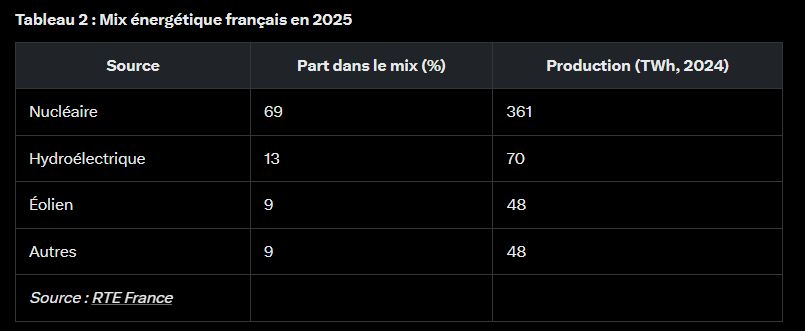
Source: RTE France https://www.rte-france.com/actualites/production-electricite-francaise-atteint-plus-haut-niveau-depuis-5-ans).
Graph 2: Comparison of Electricity Prices (2022 vs. 2035).
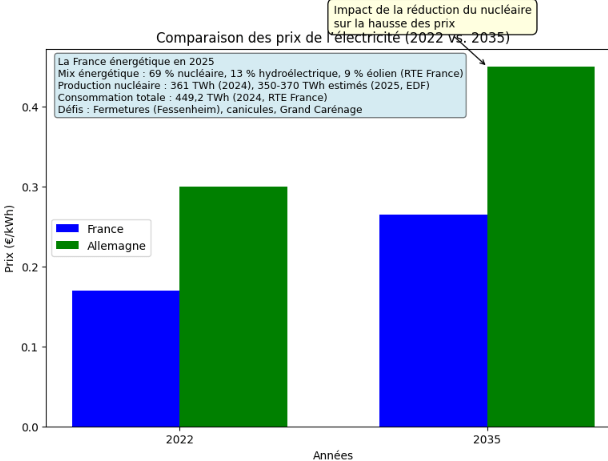
Electricity Suppliers https://www.fournisseurs-electricite.com/contrat-electricite/prix/evolution).
France’s Energy Situation in 2025.
– Energy Mix:
69% nuclear, 13% hydroelectric, 9% wind (RTE France https://www.rte-france.com/actualites/production-electricite-francaise-atteint-plus-haut-niveau-depuis-5-ans).
– Nuclear Production:
361 TWh in 2024, 350-370 TWh estimated in 2025.
– Total Consumption:
449.2 TWh in 2024 (RTE France https://www.rte-france.com/eco2mix/la-consommation-delectricite-en-france)).
– Challenges:
Closures (Fessenheim), heatwaves, Grand Carénage.
Lessons from the Messmer Plan for 2025.
The Messmer Plan shows that a crisis can be transformed into an opportunity.
In 1973, it freed France from its oil dependence, reduced emissions, and strengthened its sovereignty.
In 2025, facing the risks of degrowth and growing needs, this legacy is a source of inspiration.
Why Degrowth is Risky.
Degrowth policies, advocated by economists like Timothée Parrique (Seuil, Slow Down or Perish https://www.seuil.com/ouvrage/ralentir-ou-perir-timothee-parrique/9782021508093), aim to reduce production and consumption to lighten the ecological footprint.
However, they ignore the needs of modern industries and emerging technologies.
The stagnation of electricity consumption at 450 TWh since 2000 reflects partial deindustrialization (RTE France https://www.rte-france.com/eco2mix/la-consommation-delectricite-en-france).
Without nuclear, France risks:
– Energy Dependence:
A reduction to 50% nuclear by 2035 would increase imports and prices by 20-30% (Electricity Suppliers https://www.fournisseurs-electricite.com/contrat-electricite/prix/evolution).
– Loss of Competitiveness: Energy-intensive industries could decline, worsening unemployment.
– Social Instability:
Price increases threaten purchasing power.
International Comparison.
China, with 50 reactors and a target of 150 GW by 2035, is massively investing in nuclear.
Germany, by abandoning nuclear, depends on Russian gas and intermittent renewables, causing 20% price increases in 2022-2023.
(Clean Energy Wire https://www.cleanenergywire.org/factsheets/how-germanys-and-frances-climate-policies-and-greenhouse-gas-emissions-compare).
The Opportunity of AI and Hydrogen.
Nuclear, at 40-50 €/MWh, is ideal for powering AI, data centers, and green hydrogen, essential for decarbonizing heavy industry.
Graph 3: Growth in Data Center Consumption (2023-2030).
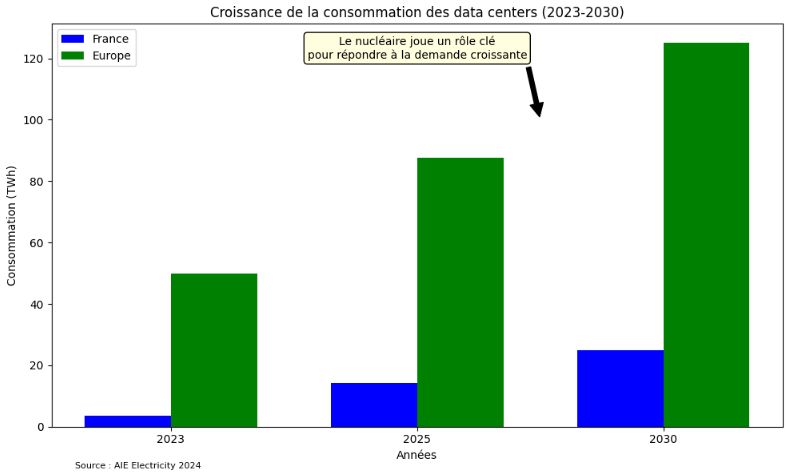
An annotation highlights the role of nuclear in meeting this demand.
Data: IEA Electricity 2024 https://www.iea.org/reports/electricity-2024).
Towards a Messmerian Revival.
To avoid an energy crisis and capitalize on 2025 opportunities, France must relaunch an ambitious nuclear strategy:
– Investments:
Accelerate the six EPR2 and Nuward. Extend the Grand Carénage (50 billion euros by 2030).
– Standardization:
Reduce costs through uniform designs.
– Sovereignty:
Strengthen leadership in civil and military nuclear.
– Innovation:
Support ITER and green hydrogen.
Table 3: Comparison of Energy Production Costs.
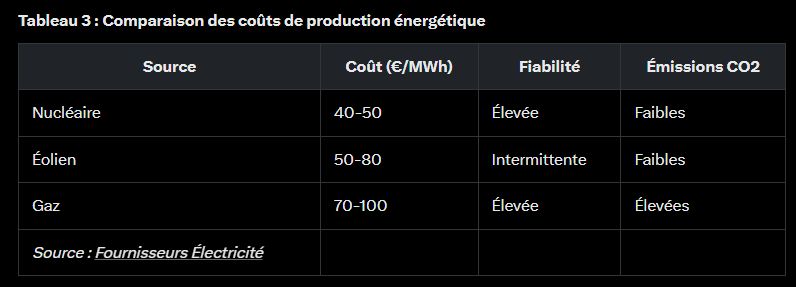
Source: Electricity Suppliers https://www.fournisseurs-electricite.com/contrat-electricite/prix/evolution).
Conclusion.
In 1973, Pierre Messmer transformed an oil crisis into an energy triumph.
In 2025, facing the risks of degrowth and the growing needs of AI and hydrogen, his legacy calls for a nuclear revival.
By combining investments, standardization, and innovation, France can ensure its sovereignty and competitiveness.
Messmer’s boldness remains the key to a sustainable future.
Sources:
– French Nuclear Energy Society: Messmer Plan https://www.sfen.org/rgn/le-plan-messmer-retour-aux-sources-du-parc-electronucleaire-francais/
– Works in Progress: Nuclear Costs https://worksinprogress.co/issue/liberte-egalite-radioactivite/
– RTE France: 2024 Electricity Balance https://www.rte-france.com/actualites/production-electricite-francaise-atteint-plus-haut-niveau-depuis-5-ans
– IEA: Electricity 2024 https://www.iea.org/reports/electricity-2024
– IWH Halle: Economic Impact https://www.iwh-halle.de/publikationen/detail/energy-transition-and-the-economy
– O2toit: Electricity Prices 2035 https://o2toit.fr/nos-actualites/economies-d-energie/evolution-prix-electricite-2030-nos-conseils-pour-faire-face-aux-previsions-2/
– Electricity Suppliers: Projections https://www.fournisseurs-electricite.com/contrat-electricite/prix/evolution
– Clean Energy Wire: France-Germany Comparison https://www.cleanenergywire.org/factsheets/how-germanys-and-frances-climate-policies-and-greenhouse-gas-emissions-compare
– Zonebourse: 2024 Production https://www.zonebourse.com/actualite-bourse/production-da-electricite-nucleaire-en-baisse-mercredi-en-france-ce7c5ed3de8afe2d
– Sustainable Development Statistics: Energy Independence https://www.statistiques.developpement-durable.gouv.fr/edition-numerique/bilan-energetique/fr/10-21-le-taux-dindependance-energetique
– EDF: 2025-2027 Estimates https://www.edf.fr/groupe-edf/espaces-dedies/journalistes/tous-les-communiques-de-presse/estimation-de-production-nucleaire-en-france-pour-2025-2026-et-2027
– Seuil: Slow Down or Perish https://www.seuil.com/ouvrage/ralentir-ou-perir-timothee-parrique/9782021508093
 Deus - Patria - Familia - Libertas